Written by: Jorie Larsen Schroeder
Reviewed by: Nina Kalus, PsyD, and Yalda Safai, MD, MPH
Transcranial magnetic stimulation (TMS) is an FDA-cleared neuromodulation therapy that directly stimulates brain structures associated with mental health conditions
TMS has been FDA-cleared to treat major depressive disorder (MDD), obsessive-compulsive disorder (OCD), anxious depression, migraine with aura, and smoking cessation
TMS is noninvasive and targets specific brain regions. Unlike electroconvulsive therapy (ECT), TMS requires no anesthesia or induced seizure; unlike oral antidepressants and esketamine, it does not come with systemic side effects.
Multiple randomized, sham-controlled trials have demonstrated that TMS can significantly improve symptoms of MDD and OCD
You likely learned about transcranial magnetic stimulation (TMS) in medical school or advanced-practice training as a treatment for depression. But you might not be familiar with which patients are candidates for this noninvasive neuromodulation therapy. If you’re getting inquiries about TMS, here’s what you need to know about when and how to refer patients for TMS therapy.
TMS therapy is an FDA-cleared neuromodulation therapy that uses magnetic energy to stimulate nerve cells in the brain, primarily to treat depression or other psychiatric disorders.
An electrical current runs through a coil positioned against the scalp to generate rapidly changing magnetic pulses. These pulses pass through the skull and induce an electric field in the underlying brain tissue, altering the activity of neurons and connected neural circuits. To treat depression, stimulation typically targets the dorsolateral prefrontal cortex, a region involved in cognitive control and emotion regulation.
Repeated stimulation over a series of sessions is thought to promote communication across brain networks associated with depression.
The scientific basis behind TMS devices dates back to Faraday’s Law of Induction from the early 1830s, but TMS as a modern treatment modality began in the mid-1980s. First used to treat neurological disorders, TMS was quickly applied to the field of psychiatry as well.
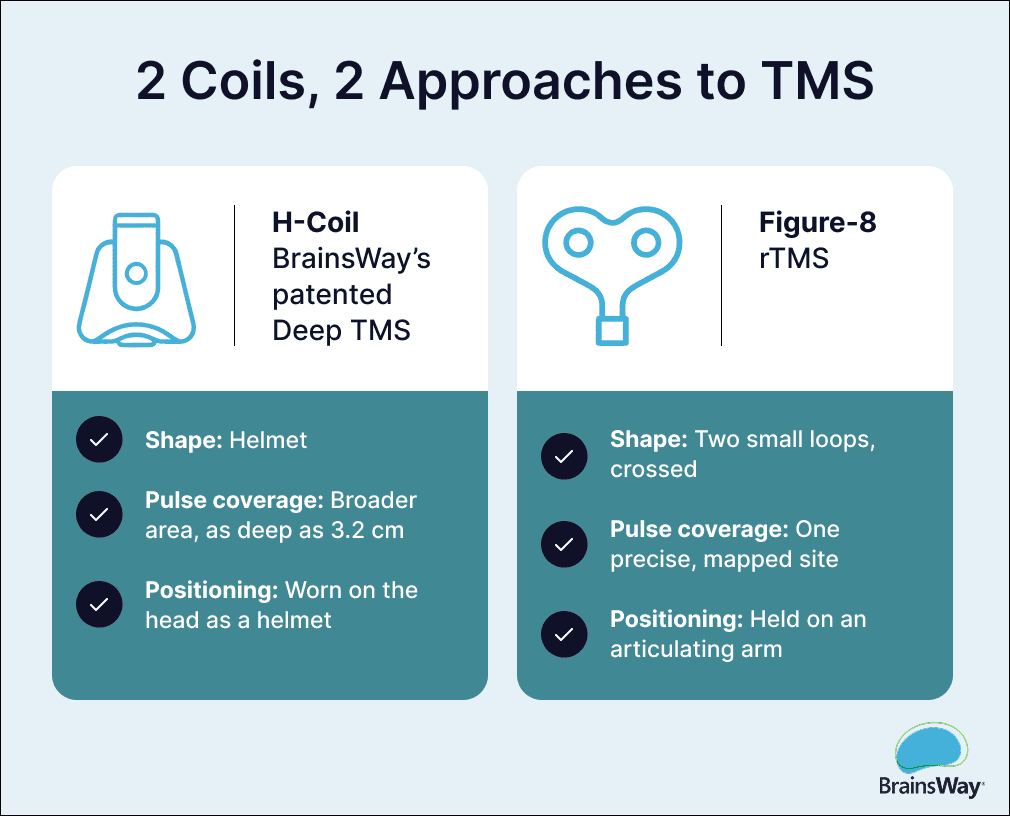
TMS is one broad treatment category of neuromodulation technologies; devices can differ in coil design, stimulation pattern, and targeting. BrainsWay’s patented Deep TMS (dTMS) machine uses H-coil technology to deliver broader, deeper pulses to a patient’s brain, as deep as 3.2 centimeters. Repetitive TMS (rTMS), also known as standard TMS, uses a figure-8 coil to deliver focused magnetic pulses that do not penetrate as deeply.
| H-Coil BrainsWay’s patented Deep TMS |
Figure-8 Coil rTMS |
|
| Shape | Helmet | Two small loops, crossed |
| Pulse coverage | Broader area, as deep as 3.2 cm | One precise, mapped site |
| Positioning | Worn on the head as a helmet | Held on an articulating arm |
The practical differences follow from coil geometry. A figure-8 concentrates its field at the single point where its two loops cross, while an H-coil distributes its field across a wider area of the scalp.
Both follow an outpatient format and similar treatment cadence.
Unlike electroconvulsive therapy (ECT) and other brain stimulation therapies, TMS does not intentionally induce a seizure or require anesthesia. That means patients can drive themselves to and from appointments. Unlike vagus nerve stimulation (VNS) or deep brain stimulation (DBS), it doesn’t require surgical implantation, either.
Broadly, TMS therapy—across the range of FDA-approved devices on the market—is cleared to treat:
BrainsWay’s Deep TMS systems are specifically cleared for MDD, anxious depression, OCD, and smoking cessation.
Researchers are also currently studying TMS to determine its effectiveness in treating post-traumatic stress disorder (PTSD), bipolar disorder, Alzheimer’s disease, and more.
TMS therapy, particularly Deep TMS, has been proven highly effective in alleviating symptoms of a number of mental health conditions.
A 2015 study published in World Psychiatry recruited more than 200 patients to examine the effect deep TMS had on patients battling major depressive disorder (MDD). They were randomly assigned to receive active or sham Deep TMS, delivered over the prefrontal cortex for 20 sessions across four weeks, followed by a maintenance phase. At week five, 38% of patients receiving active dTMS responded to treatment (compared to 21% in the sham group), while 32.6% achieved remission (compared to 14.6% in the sham group).
The efficacy of TMS on MDD has been demonstrated in clinical settings as well. In a real-world study of more than 1,300 patients receiving Deep TMS, about 4 in 5 patients who completed at least 30 sessions responded to treatment, and nearly 2 in 3 achieved remission.
Research has shown that Deep TMS is also effective in treating OCD. In a 2019 study published in the American Journal of Psychiatry, a six-week course of dTMS was offered to 99 participants, who were randomly allocated to an active or sham group. The results: 38.1% of adults in the active Deep TMS group showed significant clinical improvement of OCD symptoms, compared to 11.1% in the sham treatment group.
“The changes are often gradual and cumulative as the brain’s networks begin functioning more efficiently over several weeks of consistent treatment,” says Dr. Stefani LaFrenierre, MD, double board-certified psychiatrist and addiction medicine physician, and founder and director at Resiliency Mind + Body Medicine. “I encourage patients to look for small wins first. Maybe they’re getting out of bed a little easier, enjoying music again, finding it easier to concentrate at work, scheduling friend dinners, or noticing they’re less emotionally reactive. Those early improvements often precede larger changes in mood.”
During the first session, the provider will map a patient’s skull to evaluate the best coil placement. The physician will also conduct a “motor threshold test” to determine the minimum amount of energy required to make the patient’s finger twitch. This helps the provider set the correct stimulation parameters.
During a typical TMS session, the patient will sit in a comfortable chair while the trained practitioner fits the helmet or positions the coil, and selects the prescribed treatment protocol and individualized stimulation settings. There’s one main difference between
TMS is an outpatient procedure performed without sedation or anesthesia, so patients remain awake and alert, and typically drive themselves to and from the appointment.
A typical course of treatment is one 20-minute session, five days a week, over a period of four to six weeks, for a total of about 30 to 36 sessions. From there, many physicians will taper treatments down and offer a handful of maintenance sessions over the next few weeks. The length, frequency, and total number of sessions varies by protocol.
Most people report no significant side effects; about half of patients report a mild headache that diminishes over the course of the treatment. Some patients experience scalp discomfort or facial twitches.
TMS therapy is prescribed by medical doctors, psychiatric mental health nurse practitioners, and physician assistants, while the treatment itself is typically conducted by TMS-trained psychiatrists, technicians, or nurses under supervision.
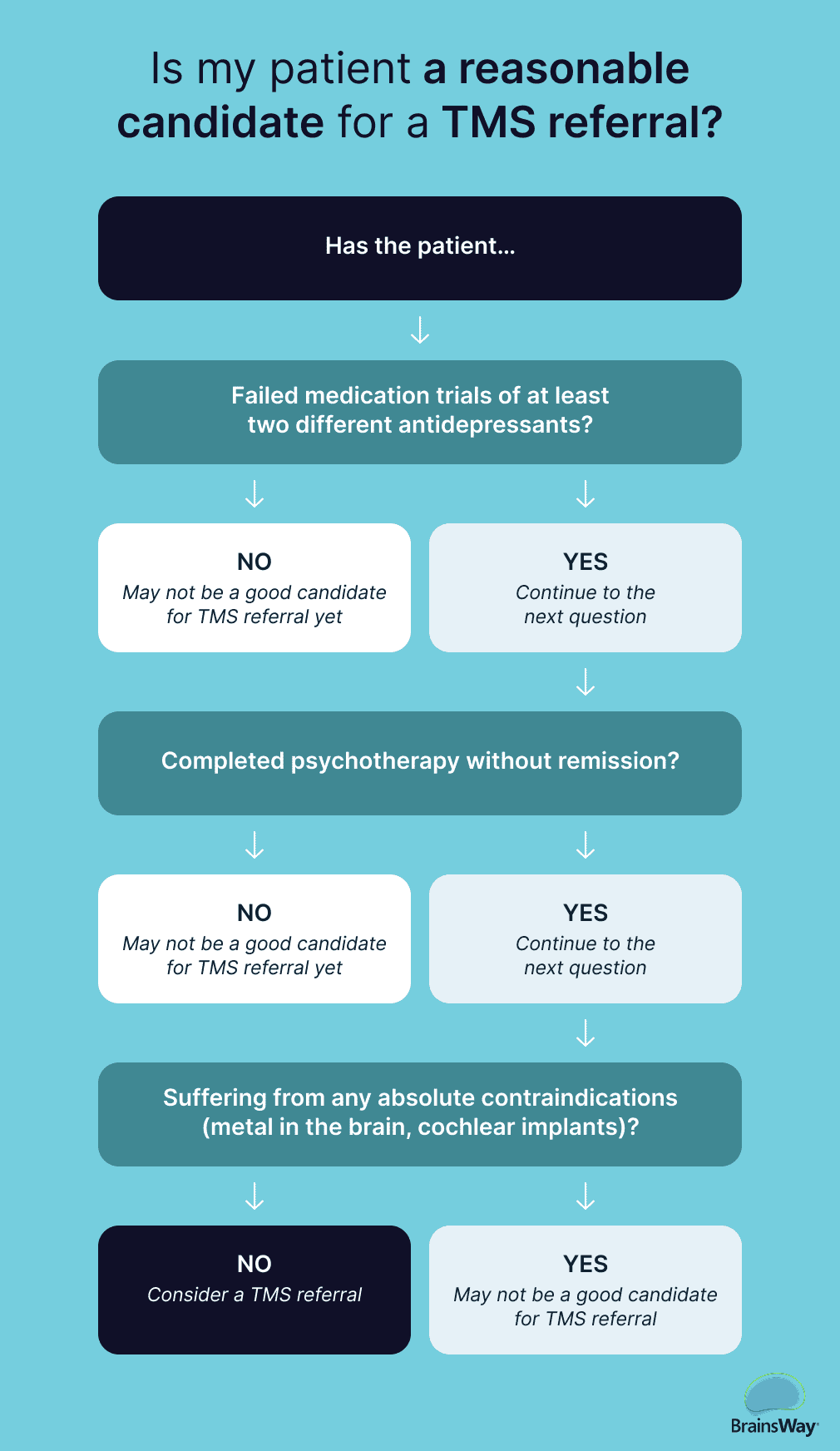
For many patients, depression is a treatable condition that responds to antidepressant medications or psychotherapy. However, for treatment-resistant depression—defined as failing to respond to two different antidepressant medications—Deep TMS is a reasonable next step. The STAR-D study (Sequenced Treatment Alternatives to Relieve Depression), a large-scale clinical trial funded by NIH, showed that after a patient has had an inadequate response to at least two different antidepressant medications, the likelihood of remission from another antidepressant alone substantially decreases.
“The earlier patients are evaluated, the sooner we can determine whether TMS fits into their treatment plan,” says Dr. LaFrenierre. “In my experience, many patients spend years cycling through medication after medication before even learning they had another evidence-based option available.”
Dr. LaFrenierre encourages primary care physicians to normalize TMS as one of several evidence-based treatment options, rather than presenting it as a last resort which “unintentionally reinforces outdated misconceptions, destroys hope, and delays patients from receiving an effective treatment.”
Dr. Irfan Handoo, MD, board-certified psychiatrist and owner of Kansas City Psychiatry Partners, noted that patients who have a biologically based family history of depression tend to respond well to TMS.
Not everyone is a candidate for TMS. It is not a good fit for the following groups of people.
Absolute contraindications for TMS include:
Patients with the following conditions require further evaluation:
Patients with the following conditions should talk to their provider to better understand if TMS is the next best step:
After a provider submits a referral, the TMS provider team will conduct an initial assessment that typically consists of psychiatric history, mental status exam, risk assessment, and TMS safety screen.
Next, the TMS provider will schedule a mapping appointment to determine the patient’s individualized treatment plan.
It’s crucial that treating patients with TMS therapy is a collaborative effort, with the referring doctor and the TMS team working toward the same goals rather than operating independently. Here are a few things to keep in mind.
Many patients want to know how TMS compares to medication and other depression treatments.
Antidepressants are usually the first line of treatment for depression, alongside psychotherapy. They’re typically taken orally, at home. Side effects vary by medication but can produce system-wide effects. When a patient fails medication trials of at least two different antidepressants, they typically become a candidate for TMS.
“The best outcomes happen when TMS is paired with healthy routines, psychotherapy when appropriate, and thoughtful medication management.” says Dr. Dr. LaFrenierre. “TMS creates an opportunity for the brain to recover, but patients still have to build on that momentum once treatment is over.”
Electroconvulsive therapy (ECT) is more invasive than TMS, as it involves inducing a seizure in patients under anesthesia in order to produce changes in brain activity. Anesthetic drugs have wide-reaching systemic effects, including nausea, confusion, and occasionally short-term memory impairment.
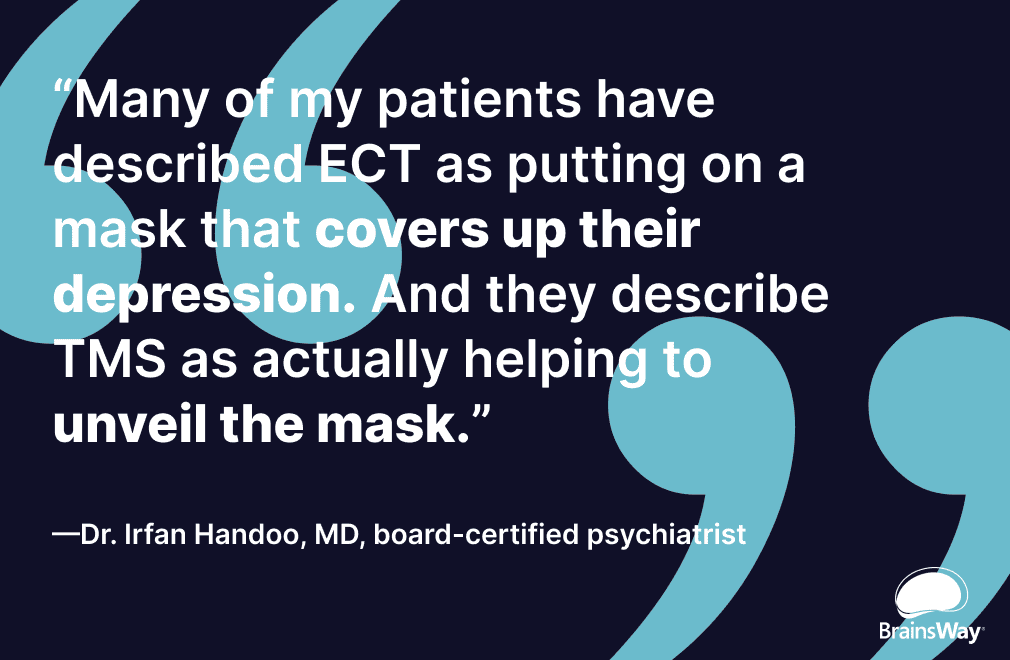
As for TMS vs. ECT, “many of my patients have described ECT as putting on a mask that covers up their depression,” says Dr. Handoo. “And they describe TMS as actually helping to unveil the mask.”
Esketamine, a nasal spray derivative of ketamine, was approved by the FDA in 2019 to combat treatment-resistant depression—but the FDA stipulated it must be taken in conjunction with an oral antidepressant. It works quickly, usually within one to three days, to relieve depression symptoms. Common side effects can include dissociation, nausea, and drowsiness, as well as a temporary increase in blood pressure.
| TMS | Medication | Electroconvulsive therapy (ECT) | Esketamine | |
|---|---|---|---|---|
| Mechanism | Uses a coil placed against the scalp to induce electrical currents in targeted brain regions. | Varies by medication class; antidepressants generally alter the production or use of neurotransmitters involved in mood and stress. | Delivers a controlled electrical current through electrodes placed on the scalp to induce a brief seizure, which produces changes in brain activity. | Blocks NMDA receptors involved in brain signaling, which may help the brain form and strengthen new connections. |
| Invasiveness & Anesthesia Usage | Noninvasive outpatient procedure; does not require anesthesia or sedation. | Usually taken at home and does not require anesthesia. | Requires anesthesia and muscle relaxants; may be performed on an inpatient or outpatient basis. | No anesthesia required. |
| Typical Course Length | 20-minute sessions carried out daily, five times a week, for four to six weeks. | Usually taken daily. | Commonly administered two to three times per week for three or four weeks. | Varies by patient; commonly administered twice a week for four weeks, then once weekly afterward. |
| Seizure Risk Profile | Rare potential adverse event. | Risk varies by medication, dosage, and individual patient factors. | Controlled seizure is the intended therapeutic mechanism. | Does not typically cause seizures. |
| Reversibility/Systemic Effects | No medication circulates throughout the body, so systemic adverse effects are limited. | Produces systemic exposure; side effects vary based on the medication. | Anesthetic drugs have systemic effects, including confusion, headache, nausea, and memory impairment. | Produces systemic effects, which can include sedation, dissociation, and temporary blood pressure spikes. |
| General Positioning in Step Therapy | Often considered after an inadequate response to 2 or more antidepressant medications. | Generally considered an initial treatment for depression. | Often reserved for severe, treatment-resistant depression. | Generally considered for treatment-resistant depression, but must be taken in conjunction with an oral antidepressant. |
If your patient is interested and well qualified for TMS therapy as the next step in their treatment plan, it’s important to describe TMS correctly.
“One of the biggest mistakes I see is describing TMS as either a miracle treatment or a last resort. Neither is accurate,” says Dr. LaFrenierre. “When I counsel patients, I explain that TMS is a process rather than a single intervention.”
Patients wear earplugs during treatment, and will experience a sensation that feels like tapping on the head and will hear loud clicking sounds.The sensation stops as soon as the machine is shut off.
Most people report no side effects, although a few report headache, scalp discomfort, or twitching of facial muscles. The provider can adjust the stimulation parameters to reduce side effects.
“I tell patients that progress isn’t always linear,” says Dr. LaFrenierre. “Some people improve steadily, while others experience temporary plateaus or fluctuations before continuing to improve. That variability is completely normal and shouldn’t be mistaken for treatment failure.”
TMS is a well-established, FDA-cleared option for several mental health conditions—the real question is when to reach for it. The referral criteria are fairly straightforward: the patient has failed adequate trials of at least two different antidepressants, and there are no absolute contraindications.
Transcranial magnetic stimulation, or TMS, is an FDA-cleared, noninvasive treatment that has been shown to improve symptoms of major depressive disorder (MDD), obsessive-compulsive disorder (OCD), migraine with aura, and smoking cessation. Because it’s an outpatient procedure that does not require anesthesia, patients can drive themselves to and from appointments and resume their normal day. Most report little to no side effects and when there are side effects, they’re usually mild.
TMS is a type of brain stimulation therapy. A primary care provider or psychiatrist may recommend TMS therapy and then refers a patient to a TMS clinic to begin treatment.
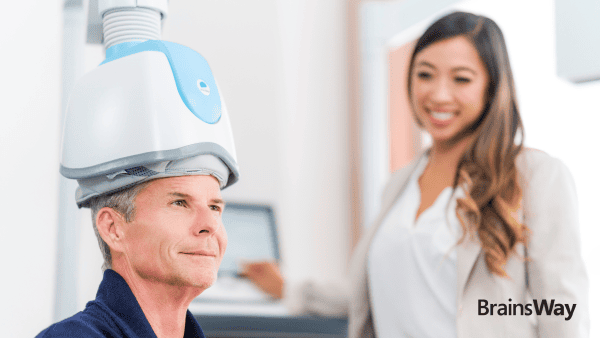
During a typical session, the patient sits in a comfortable chair while the trained practitioner positions the coil against the scalp and selects the prescribed treatment protocol and individualized stimulation settings.
TMS is an outpatient procedure performed without sedation or anesthesia, so patients remain awake and alert, and typically drive themselves to and from appointments.
A common course of treatment is one 20-minute session per day, five days per week, for about four to six weeks. From there, many physicians will taper treatments down and offer a handful of maintenance sessions over the next few weeks. Just keep in mind that the length, frequency, and total number of sessions varies by protocol.
Most people report no side effects, although a few report headache, scalp discomfort, or twitching of facial muscles. The provider can adjust the stimulation parameters to reduce side effects.
Deep dive recommendation:
TMS Considerations Checklist from the American Psychiatric Nurses Association
Reference:
Rush AJ, et al. Acute and longer-term outcomes in depressed outpatients requiring one or several treatment steps: a STAR*D report. Am J Psychiatry. 2006;163:1905–1917.