Written by: Jennifer Chesak
Reviewed by: Nina Kalus, PsyD, and Yalda Safai, MD, MPH
TMS machine cost comes down to more than just the sticker price of the device.
Practices that are considering buying a TMS machine need to factor in the total cost of ownership over time.
Other factors that build on sticker cost include payment structure and add-on equipment, software, or staffing and training costs.
Your return on investment is also a consideration, which varies based on your practice’s treatment capacity, reimbursement factors, and more.
If you’re considering buying a TMS device to provide your patients with a valuable treatment option, you may be trying to answer a crucial question: How much does a TMS machine cost?
Finding a straight answer online can be difficult. Published figures may contradict one another when referring to the same device.
Several articles only provide the upfront cost of a TMS machine, whether you’re buying or leasing. They leave out other variables determining what you’ll actually spend, such as your practice’s business model, service contracts, additional equipment, and the machine’s total cost of ownership.
This article covers all of it.
The short answer is that a BrainsWay TMS machine’s cost ranges from $100,000 to $150,000, depending on several factors.
Factors that impact the price:
When considering TMS machine cost, the main drivers of differing prices are coil/system category, cooling method, and the included software and support features—rather than simply the brand name alone.
Let’s consider cooling as a quick example of one of the variables listed below. A practice specializing in theta burst stimulation will offer shorter treatments at about three to nine minutes of total stimulation time per session, says Ben Spielberg, M.S., founder and CEO of Solstice Training Institute. This allows for more patient throughput per machine. Approximately three to four patients can comfortably be treated in an hour as opposed to just one or two with different protocols. But this is more taxing on the machine.
“It requires a robust cooling methodology,” Spielberg says, “so as to not overheat and lead to the practice canceling the rest of the appointments for the day.”
Factors impacting cost comparison of research-grade TMS systems:
Rather than comparing devices by sticker price alone, consider exploring how each system’s design affects the upfront cost, treatment capacity, and ongoing expenses. The table below provides a category-level comparison.
| Factor | Figure 8/standard rTMS | H-coil/Deep TMS | Double-cone |
|---|---|---|---|
| Cost tier | Lower to mid-range: $100,000 to $125,000 | Mid- to higher range: $125,000 to $150,000 | Mid- to higher range: $125,000 to $150,000 |
| Cooling method | Generally liquid-cooled (more time-consuming) | Generally air-cooled (least time-consuming) | Liquid or air, depending on the device |
| Throughput considerations | Cooling requirements and system-specific operating limits can affect treatment capacity | Cooling and coil design can offer increased treatment capacity | Cooling requirements may be more intensive and require more time, which may affect treatment capacity |
| Typical business models | Purchase, finance, lease, or pay per session | Purchase, finance, or lease | Purchase, finance, or lease |
| Ideal for | Solo providers and small practices seeking conventional rTMS | Practices seeking Deep TMS and expecting higher treatment volume | Practices that need protocols supported by a double-cone coil |
The TMS machine price is only part of your total cost of ownership or use. When you calculate the full cost, you need to include what you’ll pay to acquire the device and what you’ll pay over time for operating, maintaining, and eventually replacing the system.
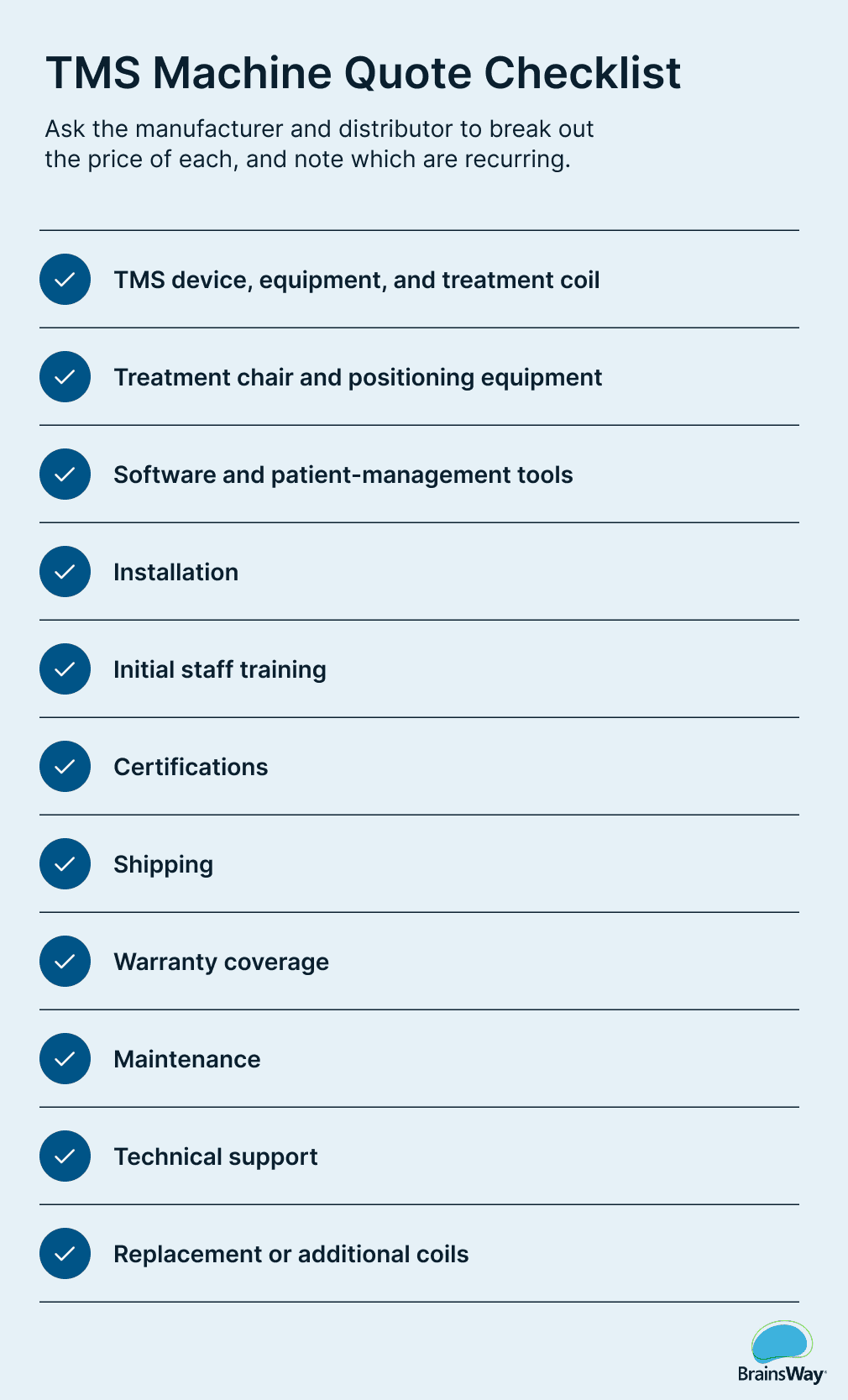
Getting an itemized quote from the manufacturers or distributors you’re considering is a great first step in determining your upfront costs.
Itemized checklist:
How you choose to pay for your machine—buy, finance, lease, or pay-per-use—will also affect cost.
Purchase
When you purchase a device, you pay the capital cost upfront and you own the equipment. Although purchasing requires the largest upfront investment when paying for a device, it does come with some incentives.
“If you have revenue or funding, you need to decide if an outright purchase makes sense, considering potential tax savings with depreciation write-offs,” says Stefani LaFrenierre, MD, a psychiatrist and addiction medical specialist and the founder of Resiliency Mind+Body Medicine. “Purchasing can provide the best long-term economics and potential tax advantages for a high-volume practice.”
Finance
Your TMS machine vendor may offer financing options directly or through a third party, or you might finance through a bank or other lender. Financing can help you spread the cost over time rather than paying all at once, which can be beneficial if you still need to cover additional costs, such as increased staffing. However, financing typically increases your total cost when you factor in interest and other associated fees.
Lease
Leasing involves paying regular fees to use vendor-owned equipment for a set period. As with financing, leasing can help you reserve funds to pay for any additional scaling up of your practice or additional equipment. “Leasing preserves capital and creates a predictable monthly expense,” says Dr. LaFrenierre.
“The lease might be cheaper on a monthly basis and offer favorable terms,” adds Spielberg. For example, you might find that leasing folds in other costs, such as maintenance and technical support. Review the terms carefully before making your decision.
Pay-per-use/session
With a pay-per-use model, your practice pays for each session. This helps reduce upfront costs, but it may increase your costs over time, especially if you increase your treatment volume, and it may have other drawbacks.
“Pay-per-treatment can reduce upfront risk for a new or lower-volume program but over time, may be the least cost-effective option,” LaFrenierre says, “as this structure can disqualify you from some insurance contracts—reimbursement is too low to cover the per-use fee.”
“Paying per treatment is almost never the right move for a practice, unless they don’t have to pay anything upfront for the machine itself,” Spielberg adds.
Purchase vs. finance vs. lease vs. pay-per-use
| Factor | Purchase | Finance | Lease | Pay-per-use |
|---|---|---|---|---|
| Upfront cost | Highest | Lower | Lower | Minimal or none |
| Payment structure | One-time purchase | Monthly payments + interest over a set term | Recurring payments during leasing period | Fee paid per session |
| Ownership | Practice owns the system | Practice owns the system only after financing period ends | Vendor owns the system | Vendor owns the system |
| Best for | Established practices with available capital | Practices that want ownership but lack the upfront capital | Practices that want predictable payments with a lower upfront investment and that don’t desire device ownership | Newer- or lower-volume practices that want minimal upfront cost |
| Main advantage | No ongoing device payments after purchase; tax incentives | Spreads cost over time | Lower initial investment with a predictable monthly fee | The lowest initial upfront cost |
| Main consideration | Largest initial upfront cost | Interest increases total cost | Total cost can exceed purchasing | Cost increases as your treatment volume increases |
When you’re considering your total cost of ownership or use of a TMS device, factor in your ongoing costs.
Potential ongoing costs:
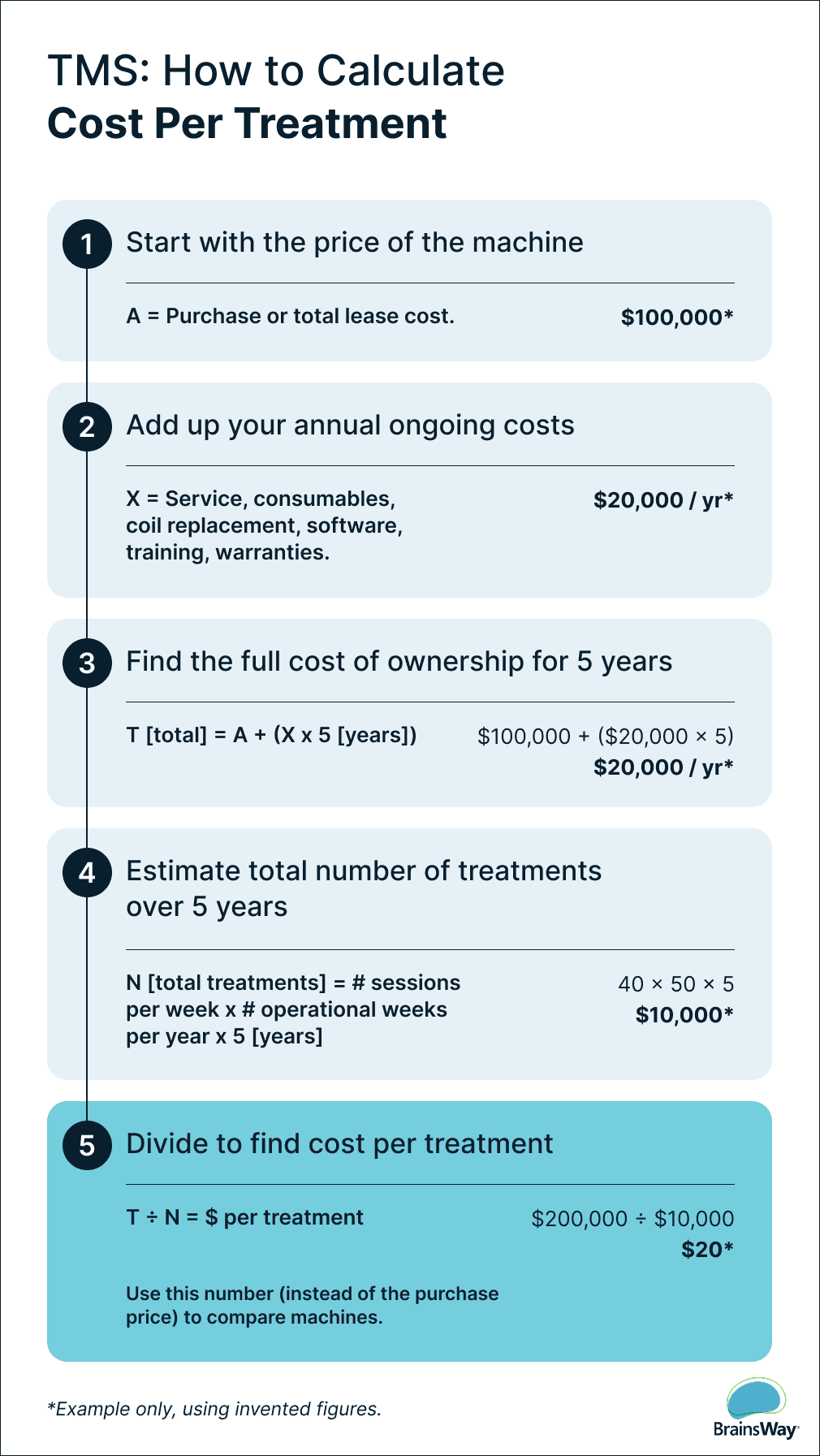
One way to compare these potential ongoing or unexpected TMS device costs across machines is to add up an annual estimate for the bulleted items above, then multiply that amount by the number of years you expect to use the device.
You can then estimate the number of treatments you expect to perform with your TMS machine within that timeframe.
Divide your total cost by the number of treatments to arrive at your cost per treatment. This number can help you better decide what business model makes the most sense for your TMS purchase.
Whether your vendor provides support is another consideration for your practice’s total cost of buying and operating a TMS machine. If a machine requires extensive downtime because of a lack of support or other issues, the downtime will affect your treatment capacity, which may affect your bottom line.
Ask your vendor:
Your return on investment (ROI) for a TMS machine depends on patient volume, insurance reimbursement rates, and your ongoing operational costs.
“The biggest mistake is focusing on the cost of the machine and reimbursement per treatment without understanding that the real ROI comes from daily utilization,” Dr. LaFrenierre says. “Practices need to realistically assess their patient pipeline, payer mix, staffing, authorization workflows, cancellations, and whether they have the infrastructure to keep the machine consistently treating patients.”
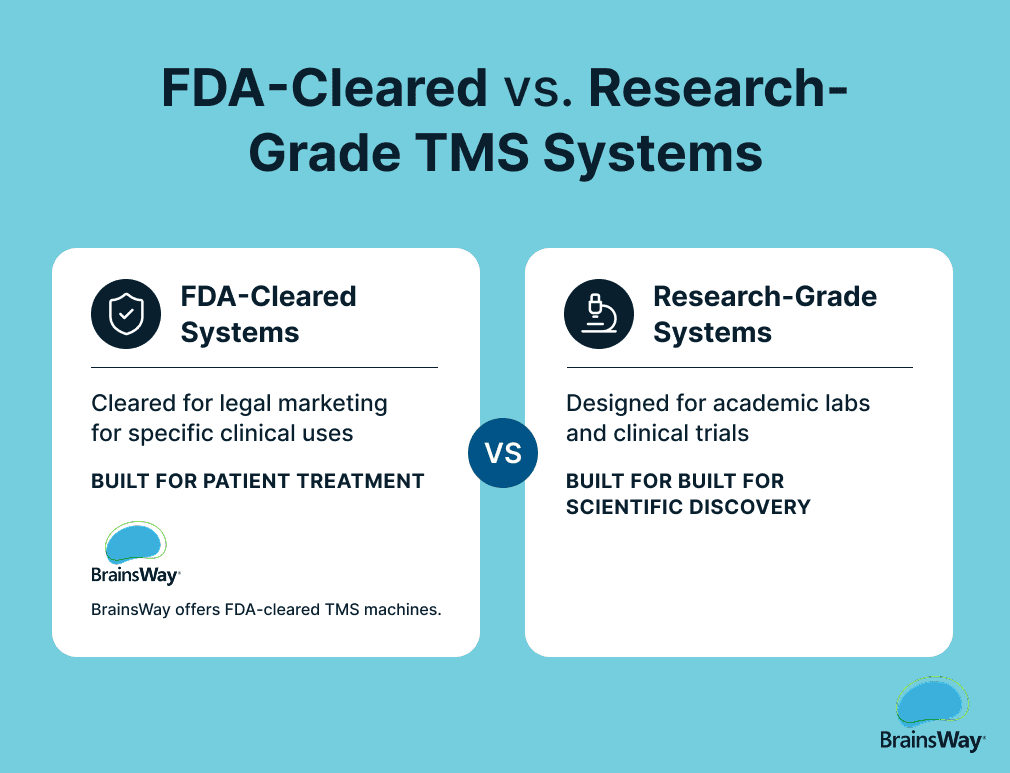
Now that you’ve factored in potential cost, you might be wondering where to buy a TMS machine. BrainsWay offers FDA-cleared TMS systems.
You can buy a TMS machine directly from a manufacturer, in many cases, or from a distributor. Buying direct has some potential advantages, including lower base pricing and direct support. Distributors, on the other hand, may offer a variety of brands, which you can compare. You might also encounter options to buy refurbished second-hand machines.
The cost of a TMS machine comes down to more factors than just what you’ll pay for the device, whether you’re buying, financing, leasing, or subscribing to a pay-per-use model. Other potential costs to factor in include any consumables, equipment replacements, software, staffing, and more.
You can estimate your costs by using the basic formula included above to figure out your practice’s total cost of TMS ownership or use.
A BrainsWay TMS machine, depending on various factors, costs between $100,000 to $150,000.
BrainsWay TMS does not offer a pay-per-use model. Once your practice buys, finances, or leases a BrainsWay TMS machine, you will not incur additional fees per treatment, aside from replacing consumables as needed. Therefore, you can estimate cost per treatment by calculating your amortization of the equipment and your total overhead expenses against your patient treatment volume, while factoring in insurance reimbursement.
TMS machines are specialized pieces of equipment that require precise engineering, rigorous testing, regulatory approval, and proper maintenance. For these reasons, manufacturers must price machines accordingly.