Written by: Elle Warren
Reviewed by: Nina Kalus, PsyD., and Yalda Safai, MD, MPH
Accelerated transcranial magnetic stimulation (TMS) shows response and remission rates comparable to standard TMS, though its evidence base is newer and less robust.
The primary advantage of accelerated TMS is its condensed treatment timeline, but the intensive daily schedule creates additional staffing and scheduling considerations.
Adding accelerated TMS may require new equipment depending on the protocol, with SAINT requiring functional MRI and neuronavigation software while SWIFT does not for practices already using BrainsWay Deep TMS.
Most insurance plans do not currently cover accelerated TMS, making payer verification and a sustainable self-pay strategy important considerations before adding it as a service line.
Whether accelerated TMS is a fit for your practice ultimately depends on your equipment, capacity, patient demand, and ability to support the financial model.
Accelerated TMS, a newer approach to transcranial magnetic stimulation, compresses treatment into multiple sessions per day over a much shorter timeline than standard TMS. Providers considering whether to offer it should factor in protocol-specific response and remission data alongside scheduling and equipment requirements and cost. This article compares leading accelerated TMS treatment protocols with standard TMS and Deep TMS, looking at the operational and financial factors that may determine whether accelerated TMS is a realistic addition to your practice.
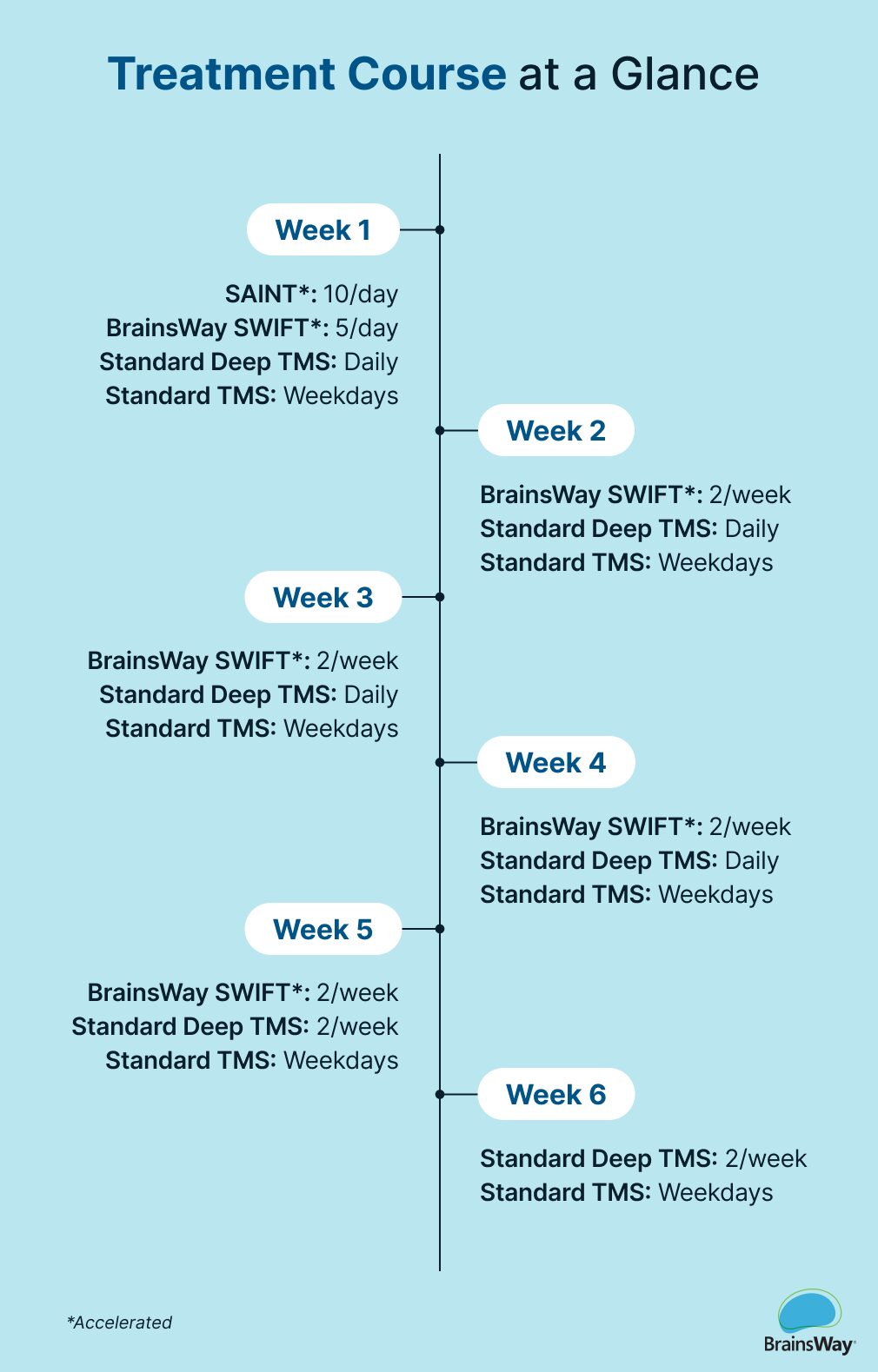
Accelerated TMS uses a specific pulse pattern called intermittent theta-burst stimulation (iTBS) that allows for multiple sessions per day, shortening the overall treatment course to as little as five days. You may also hear accelerated TMS called theta burst TMS or abbreviated to aTMS. With standard TMS, sessions are delivered once per day, five days a week, stretching the treatment course to about six weeks.
There are two FDA-cleared accelerated TMS protocols as of November 2026:
Both FDA-cleared accelerated TMS protocols use iTBS, which delivers stimulation via rapid bursts of three magnetic pulses (called triplets), at a high frequency (typically about 50 Hz). This pattern is modeled on natural brain wave activity, specifically hippocampal theta oscillations. Depending on the protocol, sessions are spaced 10-50 minutes apart and each lasts 3-10 minutes. Standard repetitive TMS, in contrast, delivers one pulse at a time, at a lower frequency (5-10 Hz), with sessions lasting around 19-37 minutes. Standard Deep TMS uses 18 Hz, with 20-minute sessions.
Both primary protocols of accelerated TMS, SAINT and SWIFT Deep TMS, are FDA-cleared to treat depression with promising response and remission rates.
In one double-blind, randomized sham-controlled trial of the efficacy of the SAINT protocol, the response rate, measured as a 50% or greater reduction in the Montgomery-Åsberg Depression Rating Scale (MADRS), was more than 85%. The remission rate, measured as a MADRS score of 10 or less, was over 78%. In the sham group, those rates were about 27% and 13%. It’s worth noting, however, that the trial included only 29 people, 14 of whom received active treatment.
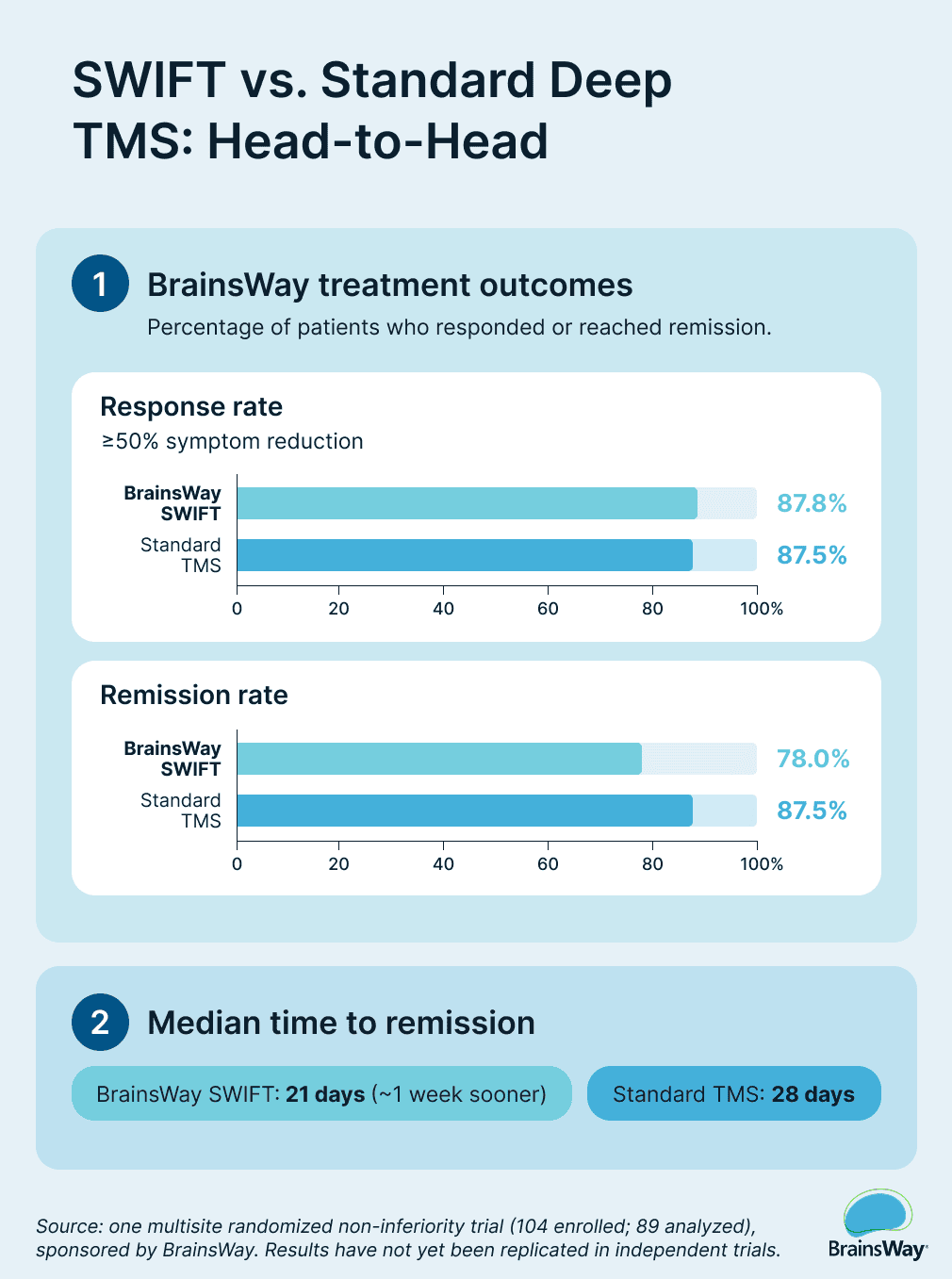
A multicenter, randomized non-inferiority trial with 89 participants (104 enrolled) analyzing the efficacy of the SWIFT protocol, which does not require MRI equipment, found comparable results. Accelerated Deep TMS for depression response and remission rates were more than 87% and 78%, respectively, compared with 87.5% for both in the standard Deep TMS group. In the accelerated protocol, the median time to remission was 21 days, one week faster than the median onset of remission for standard TMS. The trial found accelerated Deep TMS non-inferior to the standard protocol. Note that this research was sponsored by BrainsWay.
“What we typically see in standard TMS is the beginning of a response by session 20, or week four. Accelerated patients can see full remission within a one- to two-week time frame,” says Stefani LaFrenierre, MD, psychiatrist and founder of Resiliency Mind+Body Medicine.
Because of its faster time to relief, one use for accelerated TMS is treating patients with suicidal ideation. Some randomized, sham-controlled trials have found greater reductions in suicidal ideation with active accelerated iTBS than with sham, while a recent meta-analysis of suicidality outcomes found no significant advantage over sham or standard TMS. Both SAINT and SWIFT are FDA-cleared for major depressive disorder, not specifically for suicidal ideation.
It’s worth noting that while the body of evidence for accelerated TMS is promising, it’s less robust than that for standard TMS. As the authors of a 2025 systematic review comparing accelerated TMS with standard or sham rTMS put it, “In the aTMS studies published to date, due to limitations such as small sample sizes, methodological heterogeneity, and suboptimal control conditions or targeting methods, it is not possible to draw clear and definitive conclusions at present.”
The evidence above, like most research on accelerated TMS, focuses on depression. There is far less research on accelerated TMS for anxiety, and it is not FDA-cleared to treat anxiety disorders.
The existing research on accelerated TMS for anxiety is highly limited. One study of accelerated TMS for depression also evaluated anxiety and found it “significantly decreased” among the 14 participants. In a case study, a patient with depression similarly experienced a drop in anxiety.
A systematic review and meta-analysis, however, looked at seven randomized controlled trials in patients with OCD. It found that accelerated TMS significantly reduced OCD and depression symptoms by the end of treatment, but it did not significantly reduce general anxiety symptoms, which were measured separately from OCD severity. At follow-up, only the improvement in depression had lasted.
Because this review measured anxiety only in people with OCD, not in people being treated for an anxiety disorder, it can’t tell us whether accelerated TMS works for anxiety itself. More studies in people with anxiety disorders are needed before it could become a standard anxiety treatment.
Due to its much quicker timeline, accelerated TMS can be a great option, especially for patients looking for faster relief. But it also comes with downsides related to expectation setting, intensive scheduling, and cost.
The condensed timeline of accelerated TMS offers two primary benefits.
The newness of accelerated TMS, compared to standard, plus the intensive daily commitment, may come with challenges.
In this comparison, “Deep TMS” refers to standard Deep TMS, not the accelerated protocol. first-generation TMS has the longest history of evidence supporting response, remission, and durability, but current research on both accelerated TMS and Deep TMS show higher rates of response and remission.
That said, response and remission data is difficult to compare directly, due to variables in patient population and other study factors. The data below provides a general overview.
| Factor | Accelerated TMS | first-generation TMS | Deep TMS |
|---|---|---|---|
| Also known as | aTMS, theta burst TMS | rTMS | dTMS |
| Mechanism | Figure-8 coil for SAINT protocol
H-coil for SWIFT protocol (BrainsWay’s accelerated TMS) |
Figure-8 coil | H-coil |
| Session length | 3–10 minutes | 19–37 minutes, depending on the device | 20 minutes |
| Sessions per day | 5–10 | 1 | 1 |
| Total course length | SAINT: 5 days
SWIFT: 6 days, followed by 4 weeks of twice-weekly sessions |
6–7 weeks | 6 weeks |
| Response/remission rates | 87% response, 78% remission |
60% response, 40% remission (varies by machine) |
81.6% response, 65.3% remission |
| FDA-cleared indications | SWIFT and SAINT: Depression
SWIFT: Major depressive disorder (MDD) with comorbid anxiety symptoms |
Clearances vary by device but include depression and OCD | Depression, OCD, smoking cessation, and MDD with comorbid anxiety symptoms |
| Evidence-base maturity | Newer | Established | Robust |
Side effects and safety: accelerated vs. standard TMS
Accelerated TMS generally has the same safety and side effects profile as standard TMS. According to a systematic review and meta-analysis on the efficacy and safety of accelerated TMS, no serious adverse events have been reported. Side effects are generally reported as mild and resolve without intervention; the most common are headache and local pain.
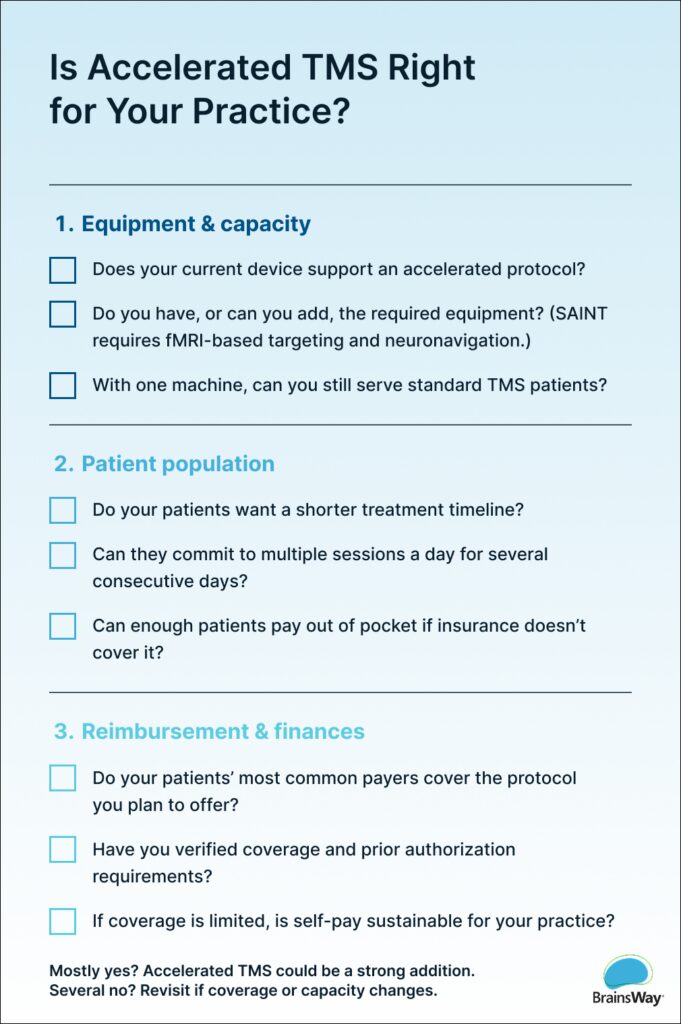
The biggest factor to consider from the operational side is scheduling. For example, if you only have one TMS machine, an accelerated TMS patient may take up the entire treatment day, unless you’re treating accelerated patients whose sessions you can stagger.
“You would need multiple patients doing that same type of treatment at the same time to make that time slot as efficient as the first-generation time slot,” says TeeJay Tripp, PsyD, chief medical officer of Serenity Mental Health Centers.
Dr. LaFrenierre says it’s also worth thinking about your space. Since patients will be in your office for several hours, “You need a nice area for a patient to relax in between treatments, and sometimes the waiting room just isn’t it.” Consider whether you can set aside a comfortable space where patients can relax between sessions.
Accelerated TMS can come with significant cost considerations for your practice, depending on your TMS machine.
The SAINT accelerated TMS protocol requires functional MRI and neuronavigation software, which can cost between $30,000-$80,000 if purchased separately. Some TMS machines may come with this software included. BrainsWay’s SWIFT protocol does not require additional equipment. In either case, while there aren’t any additional formal licensing requirements, your TMS machine provider should supply accelerated TMS-specific training resources.
“BrainsWay does a good job of helping provide that support,” says Dr. Tripp.
Because accelerated TMS is newer than standard TMS, most insurance providers don’t cover it. Depending on your client population, you may or may not be able to consistently schedule patients for accelerated TMS.
Before committing to accelerated TMS as a service line, verify coverage requirements with the payers most commonly used by your patient population. Confirm whether accelerated protocols are covered under the patient’s plan, whether prior authorization is required, and whether the specific protocol and device you plan to use meet the payer’s criteria. If accelerated TMS is not covered, determine whether your practice can support a self-pay model and clearly communicate expected costs to patients before treatment begins.
Though insurance coverage is currently limited, Dr. LaFrenierre notes that insurance policies are slowly starting to shift.
The decision of whether to incorporate accelerated TMS into your treatment offerings depends on your machine and scheduling capacity as well as whether enough of your patient population is willing or able to spend $6,000–$36,000 on treatment.
BrainsWay provides Deep TMS devices that support accelerated TMS, no extra equipment needed.
Accelerated TMS shows promising efficacy data for depression and potential benefits for patients seeking faster relief. “It’s just nice to have more ways to help out patients and try not to have that time constraint be the reason why they can’t feel better and take back their life,” says Dr. Tripp.
However, its newer evidence base, intensive treatment schedule, equipment requirements, and limited insurance coverage make it a different operational proposition from standard TMS. Before adding accelerated TMS, evaluate whether your current equipment and staffing can support multiple sessions per patient each day, and whether you have enough patient demand to use treatment capacity efficiently. Also consider whether your payer mix or self-pay model can support the service.
Research suggests accelerated TMS can be comparably effective to standard TMS for depression. The largest randomized trial to date found accelerated Deep TMS non-inferior to standard Deep TMS, and other studies report promising response and remission rates. However, accelerated TMS has a newer and less robust evidence base, with smaller samples and greater methodological variation. So it’s best not to directly compare response and remission rates across protocols or studies.
Most insurance plans don’t currently cover accelerated TMS. Before offering the treatment, practices should verify coverage and prior authorization requirements with the payers their patients use most often. Confirm both that the specific protocol and device meet the payer’s criteria. If it’s not covered, practices should determine whether a self-pay model is financially sustainable.
The cost depends largely on the accelerated protocol and the equipment a practice already has. For example, the SAINT protocol requires functional MRI and neuronavigation software. The software can cost approximately $30,000–$80,000 if purchased separately. The SWIFT protocol does not require additional equipment for practices that already use BrainsWay Deep TMS. Practices should also account for staffing, scheduling capacity, training, and the financial impact of limited insurance coverage when evaluating the total cost of adding accelerated TMS.
To screen existing patients for accelerated-protocol candidacy, start with a few essential questions. One, is accelerated TMS is appropriate for their clinical indication? Two, can they commit to multiple treatment sessions per day over several consecutive days? Three, is the treatment is financially accessible to them? For SAINT, patients must also be able to undergo MRI.