Written by: Elle Warren
Reviewed by: Nina Kalus, PsyD
TMS equipment is primarily differentiated by coil type (figure-8 and H-coil) and protocol capability (rTMS, Deep TMS, TBS, and accelerated TMS).
Factors to consider when evaluating TMS devices include total cost of ownership, pricing model, and the reliability of the vendor’s service and support.
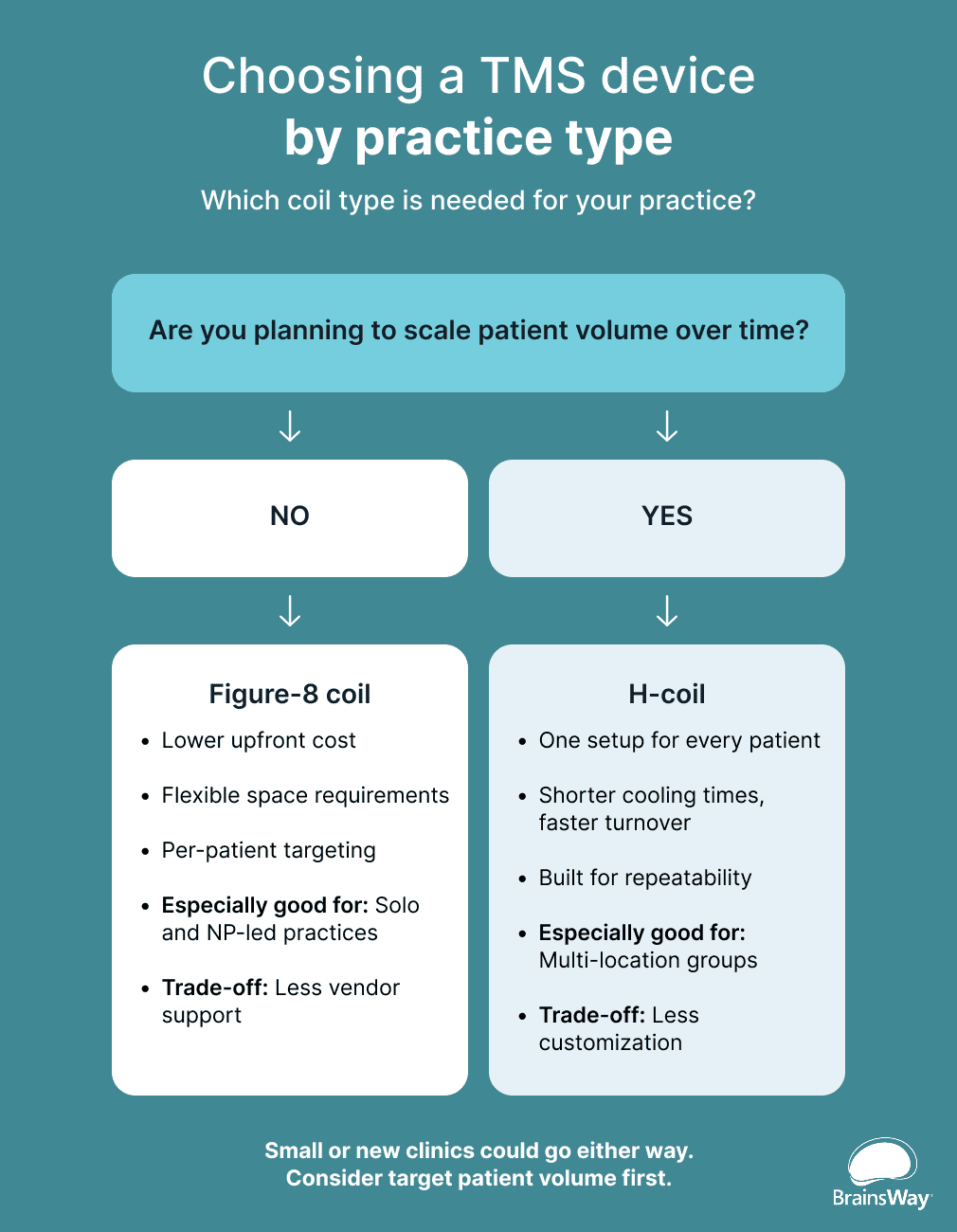
Multi-location clinics, or practices looking to scale, may prefer the standardization offered by H-coil devices, while solo-led practices may opt for more customizable figure-eight machines that require more operational oversight.
The best TMS machine for your practice depends on your goals for volume and growth.
First-time TMS device purchases can either be a worthwhile investment or a costly regret, depending on the machine and the needs of your practice. There’s no one-size-fits-all answer to which TMS device will be the best fit—instead, it varies by the size of your practice, patient volume, and whether you’re looking to scale. Keep reading to understand the real factors that differentiate TMS devices from each other, what criteria actually matters when evaluating devices, and what questions to ask TMS device manufacturers before purchasing their product.
The primary differences between TMS devices boil down to coil type, which TMS protocols they’re designed for, and their cooling systems. Understanding these differences helps determine which machine is best for your practice.
The type of coil that a TMS device contains determines the depth and broadness reached by its magnetic pulse. There are two main types of coils: figure-8 coils, which provide more surface-level stimulation, and BrainsWay’s TMS device’s patented H-coil, which provides broad, deeper stimulation.
Ben Spielberg, M.S., founder and CEO of Solstice Training Institute, says, “There are benefits and trade-offs to both.”
A figure-8 coil might offer more flexibility, Spielberg explains, because the magnetic field is much smaller compared to the deeper, broader coils.
However, the broader focus of an H-coil device like BrainsWay’s comes with advantages, too. Treatment is more standardized from patient to patient, which means less operational oversight and room for error. This is often ideal for those looking to scale their TMS business, Spielberg says: “You want something that is more in the realm of one-size-fits-all, where you don’t have too many options to choose from, and you know it’s going to work well for most patients.”
The broad stimulation of H-coils also makes them better suited to treat a wider number of conditions. H-coils are cleared to treat major depression—including the reduction of comorbid anxiety symptoms, commonly referred to as anxious depression—as well as OCD and smoking cessation.
Figure-8 coils are typically cleared to treat major depression, with some treating OCD and anxious depression.
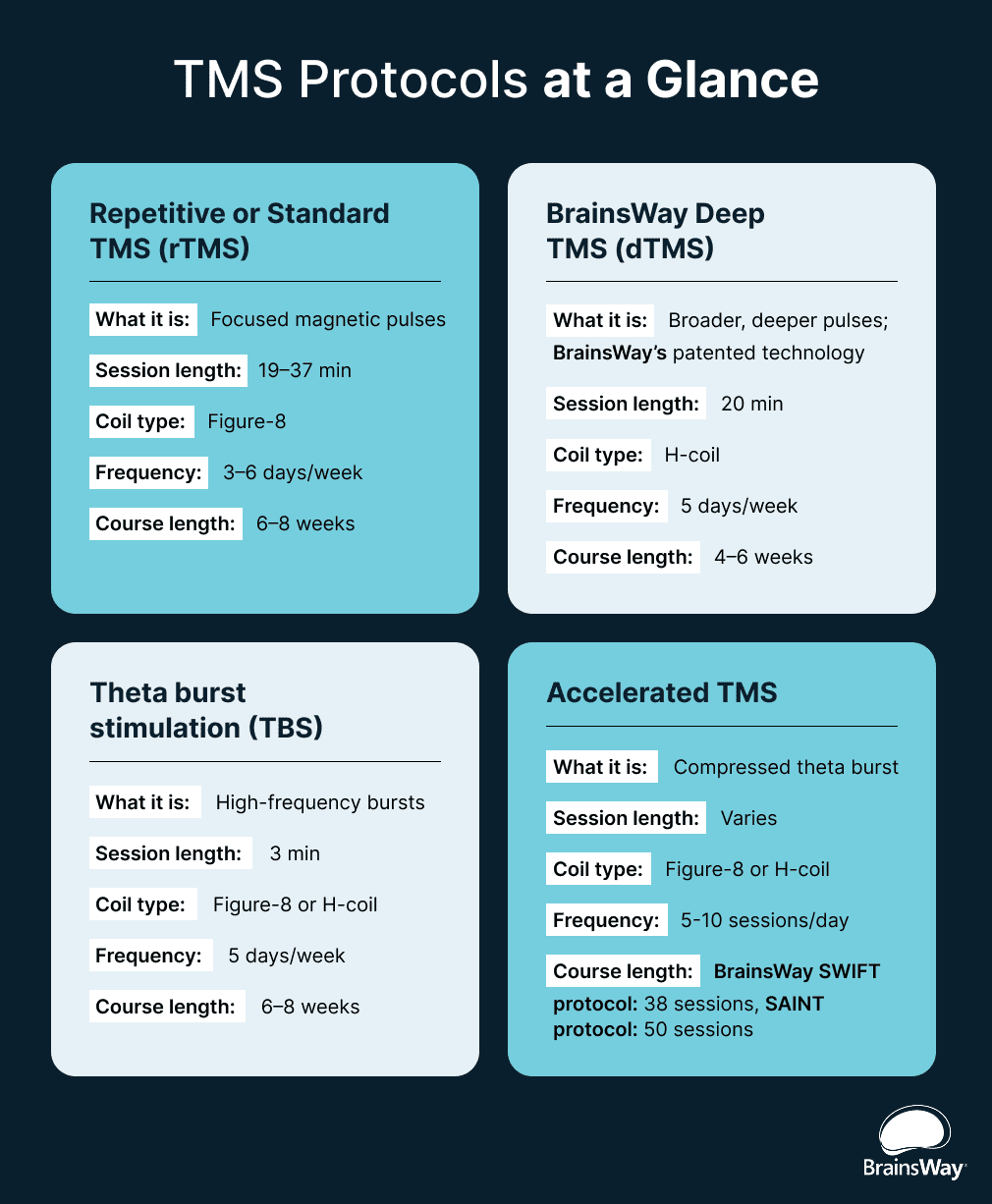
TMS protocols are delivered based on the coil type and individual device. They include the following.
Repetitive rTMS (rTMS): Also known as standard TMS, rTMS uses a figure-8 coil to deliver focused magnetic pulses. Sessions run 19 to 37 minutes and take place three to six days per week for six to eight weeks.
Deep TMS (dTMS): BrainsWay’s patented Deep TMS uses H-coil technology to deliver broader, deeper pulses. Sessions last 20 minutes and take place five days per week for four to six weeks.
Theta burst stimulation (TBS): Both figure-eight and H-coil devices have the ability to provide theta burst stimulation, though approval varies by device. Stimulation is delivered in short, high-frequency bursts, with sessions lasting just three minutes. Treatment lasts six to eight weeks.
Accelerated TMS: A faster approach to theta burst, accelerated TMS compresses weeks of sessions into days, with multiple sessions daily, sometimes followed by a weekly taper. Accelerated protocols differ by device, mainly in how they find the target.
Most figure-8 coil machines are FDA-cleared for rTMS, TBS, and accelerated TMS protocols. H-coil machines are cleared for Deep TMS, TBS, and accelerated TMS.
Between rTMS and Deep TMS, both are considered safe and effective. However, while more research is needed, studies show improved response rates and symptom reduction when using Deep TMS.
TMS device cooling systems are typically powered by liquid, air, or by passive cooling, meaning they don’t have their own cooling system.
The cooling system is relevant depending on the volume of your practice. Spielberg explains, “If you have a machine that can’t handle [high-volume operation], it’ll stop throughout the day because it’s overheated and needs to cool down for an hour, which doesn’t work when you’ve got patients scheduled back-to-back.”
Figure-8 coils more often have a liquid-based cooling system, which can be more time-consuming and noisy. H-coil devices have faster, quieter, air-based cooling systems.
Both Spielberg and Justin Gammill, co-founder of Rise4, a mental health marketing agency that provides consulting for TMS practices, noted no universal difference in patient tolerability between rTMS, or figure-8 coils, and Deep TMS, or H-coils. Both types of TMS are well-tolerated with mild side effects.
In terms of overall comfort, H-coils, which are placed on the patient’s head via a helmet, allow the patient to move more freely during the treatment session. Patients may find this more comfortable than figure-8 coils, which must be precisely placed and, therefore, restrict patient movement.
| Figure-8 coil | H-coil | |
|---|---|---|
| Commonly known as | Standard TMS, rTMS | Deep TMS, dTMS |
| Stimulation depth and breadth | 1–2 cm, focused stimulation | 3–4 cm, broad stimulation |
| Protocols supported (varies by device) | rTMS, TBS, accelerated TMS | Deep TMS, TBS, accelerated TMS |
| Cleared to treat (varies by device) | Major depressive disorder (MDD), MDD with anxiety (aka anxious depression), OCD | Major depressive disorder, anxious depression, OCD, smoking cessation |
| Cooling method | Typically liquid (water or oil), more time-consuming; less suited for back-to-back appointments | Air; faster and more suited for repeated operation |
| Patient tolerability and comfort | Generally well-tolerated; movement is restricted during treatment | Generally well-tolerated; patients may move more freely during treatment |
| Space required | Varies by device | Requires ~8 × 10 feet |
| Cost | $–$$$ (varies by device) | $$$ |
| Ideal for |
|
|
When evaluating which TMS device is right for your practice, the most important factors are total cost of ownership, the business and payment model, vendor reliability and support, and the setup, space, and staffing requirements.
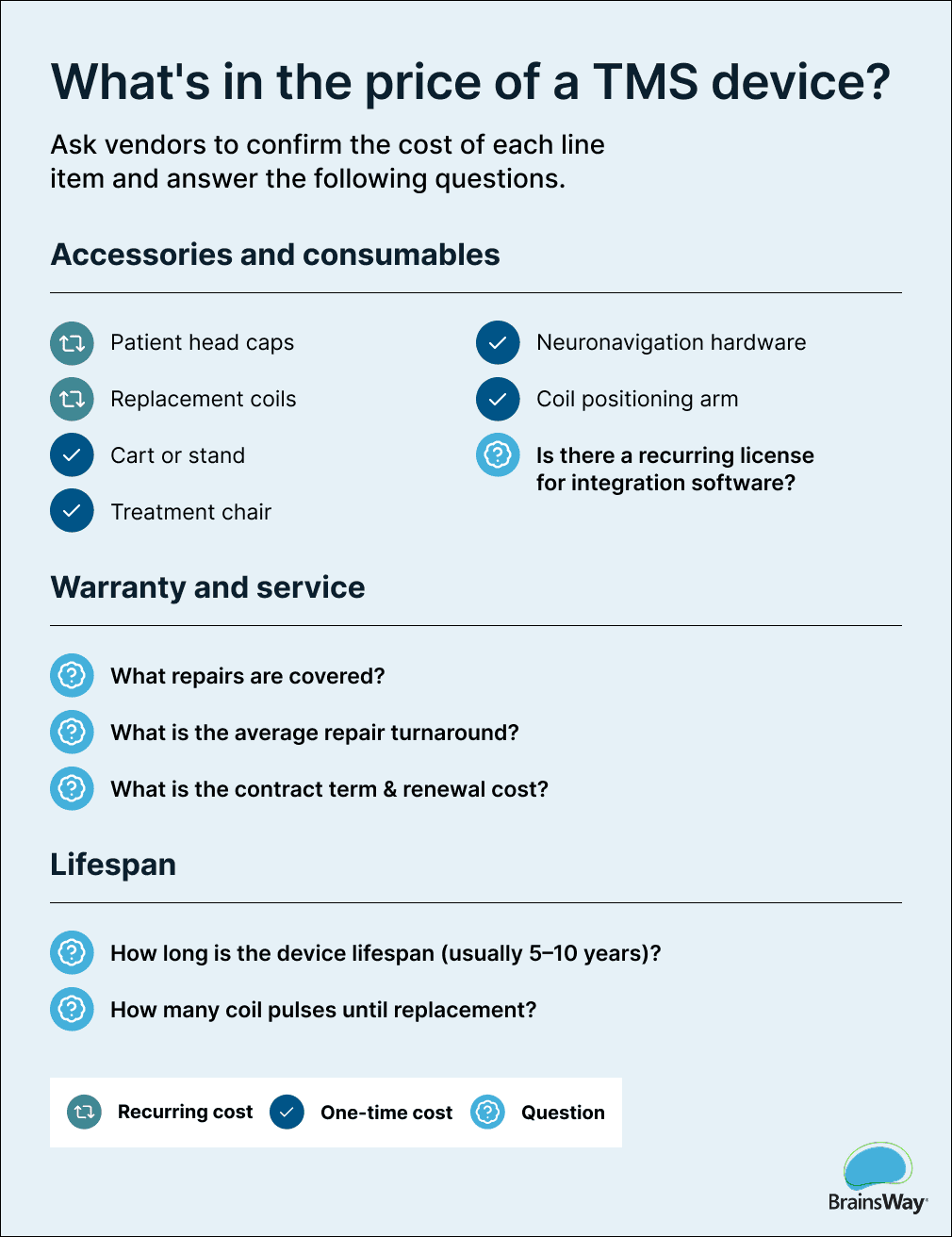
Budget is a central consideration when evaluating TMS devices. However, it’s important to evaluate the total cost of a TMS device—looking beyond the upfront price alone. Figure-8 coil devices tend to be less expensive than H-coil devices, but there are a few other ongoing costs and factors that can inflate the total cost of ownership.
Some TMS device manufacturers offer just one way to purchase their device, while others offer multiple payment models. Which route you go largely depends on budget and personal preference. These are the most common payment models TMS device manufacturers offer:
Vendors offer varying levels of ongoing practice support. According to Gammill, that may be the most important thing to consider. “Who do you want to partner with long-term?” he says. “Not just someone who’s going to drop the device off, but someone who can work with you as you grow your practice.”
More support may come with a higher price tag, but that should be weighed against the benefits that come with it, such as insurance reimbursement, lead generation, optimized workflows, and quick turnaround times.
The types of support TMS vendors may offer generally fall into the following categories:
Device sizes and space requirements vary. Typically you’ll need 8×10 to 10×10 feet to meet clearance requirements, but some devices are more compact.
Noise is another consideration, especially if you have multiple therapy rooms or a small office. TMS devices make a repetitive clicking sound during treatment. However, standard therapy room soundproofing should be sufficient to stifle the noise.
Most TMS device manufacturers deliver and set up their device for you. They also provide live, in-person training, wherein after the attending staff will receive TMS technician certification. In most states, “[Operating a TMS device] doesn’t require any type of education other than the certification that’s provided by the manufacturer,” says Gammill.
When evaluating TMS device options, consider what higher upfront costs typically afford: vendor reliability, extensive and timely support, flexibility in the device’s protocol capabilities, and the lifespan of the device and its parts. TMS device price points can range from $50,000 to $200,000, but a less expensive sticker price doesn’t always guarantee you’ll spend less to operate a device over time.
Let’s say you purchase a device on the lower-end of the upfront cost spectrum. If the vendor doesn’t offer timely, reliable support—taking a week to repair your machine or send a replacement part—you lose a week of revenue. A device with higher upfront cost is more likely to come with fast turnaround times, so you sacrifice little to no revenue.
Similarly, a lower-cost device might have coils that need to be replaced in half the amount of time as a higher-cost device.
Think about price as both a short- and long-term variable. And when analyzing different vendors, understand what the long-term price looks like.
Choosing the right TMS device for your practice depends on whether you’re planning to scale your practice as well as your short- and long-term budget. Choosing a TMS system for multiple-clinic locations is not the same as choosing an affordable TMS device for a nurse practitioner.
“I think the most important thing is to figure out what type of clinic you are now and what type of clinic you want to be in a few years,” Spielberg says. Practices looking to scale will have an easier time doing so with H-coil devices, while practices who plan to stay low-volume might prefer the flexibility of figure-8 coil devices.
If you’re looking for how to choose a TMS device as a nurse practitioner or solo practice, budget is likely top of mind. And you might not want to attract the kind of volume that a multi-staff clinic would. In this case, a figure-8 coil device, which can be personalized to each patient and has more variability in cost and space requirements, may make sense. Just keep in mind that the lower cost may come with less vendor support.
Best fit: Figure-8 coil device typically, but small practices with growth plans should consider H-coil as well
Small or new psychiatric clinics should determine their target patient volume and growth plans before choosing a TMS device. Clinics aiming for higher volume and faster growth may be better served by an H-coil device. The one-size-fits-all setup and shorter cooling times make it easier to keep the chair turning over in high-volume settings. Affordable TMS equipment for small psychiatric clinics that plan to stay lower-volume, where patient volume isn’t the primary constraint on revenue, usually means a figure-8 device given the lower entry costs and greater flexibility in targeting and protocols.
Best fit: H-coil or Figure-8 coil device, depending on patient volume and planned growth
Multi-location behavioral health groups typically prioritize scalability and standardization. In this case, H-coil devices are a better fit.
“If you want to build a company that runs a TMS business well and is something that can actually scale, then you generally want something that’s easy because complexity really gets in the way of scaling,” explains Spielberg.
Figure-8 coil devices are built around treatment customized to each patient, while H-coil devices are meant for higher-volume settings where the same process is repeatable.
Best fit: H-coil device
FDA-cleared TMS devices can be purchased directly from the manufacturer, through third-party distributors, or secondhand. Buying directly from the manufacturer tends to give you the full extent of their service, support, and warranty. Those benefits may be less reliable or nonexistent when you buy from a distributor, depending on whether they’re a manufacturer-approved distributor or not.
When you go the secondhand or refurbished route, you will not receive the support that accompanies a new device. This option saves capital upfront, but coordinating your own training, machine service, and other support needs can add up—and be a major headache—over time.
For research-grade TMS systems, which allow wider experimentation with the machine’s controls and are not FDA-cleared for clinical use, you can find devices through certain manufacturers or via a distributor.
BrainsWay offers FDA-cleared TMS systems
Every TMS device involves tradeoffs. Choosing the right one for your practice comes down to your priority: whether you want to standardize and scale TMS treatments (H-coil) or personalize each patient’s treatment (figure-8 coil). But the upfront price tag is only part of the picture. You should also weigh the total cost of ownership, the vendor’s payment model, and the reliability of their support services. An H-coil device may cost more at the outset, for instance, yet save you money over time if that cost includes ongoing support and service.
When looking for where to find reliable TMS therapy systems for clinics, ask a lot of questions. Start with when and how to contact the vendor, how quickly they respond to customers, and what their average turnaround time is for repairs. You don’t have to just take their word for it, either. If the manufacturer has testimonials on their website, you can try reaching out to the quoted practices for more in-depth information.
It depends. If you have a strict budget, it might be worth it—but not if you’ll end up spending more on service and support. When searching for affordable TMS systems for new mental health clinics, evaluate the total cost of device ownership, including not just the upfront price but the necessary accessories and consumables, service and warranty contracts, and lifespan of the device and its parts. This criteria will point you in the right direction of whether a device that’s cheaper upfront is actually worth it in the long run.
Installation and training typically takes just a day or two, but many TMS machine providers have a three- to six-month program that goes beyond initial installation and training and helps you fully integrate the machine into your practice.
Having the same TMS device at every site of a multi-location practice has advantages. It optimizes workflow and standardization, and, if you have staff that circulates more than one location, they won’t need to be trained in more than one device. Additionally, you’ll only have to coordinate service and support with one manufacturer, not multiple.