Written by: Jennifer Chesak
Reviewed by: Nina Kalus, PsyD, and Yalda Safai, MD, MPH
“Brain stimulation therapy” is an umbrella term encompassing several evidence-based modalities.
These include electroconvulsive therapy, vagus nerve stimulation, deep brain stimulation, magnetic seizure therapy, and transcranial magnetic stimulation.
Each type of brain stimulation uses different mechanisms, has a different FDA status, and has different indications.
Brain stimulation therapies treat a wide range of conditions beyond depression.
Brain stimulation therapy is a category of medical procedures that use electrical currents or magnetic fields to stimulate or inhibit specific brain areas. These therapies can help treat mental health and neurological conditions, especially when first-line treatments—such as medications, talk therapy, or lifestyle changes—have not been effective.
Each type of brain stimulation therapy differs in invasiveness, target, and mechanism of action. Most of the modalities included here use devices and protocols cleared or approved by the U.S. Food and Drug Administration (FDA), though indications for specific conditions vary. In some cases, providers may administer a brain stimulation therapy off-label for an unapproved use.
In this article, we cover the different types of brain stimulation therapy, how they work, what they’re indicated for, practical considerations for referral, and more.
Brain stimulation therapy uses electricity or magnetic fields to calm overactive or stimulate underactive regions of the brain or to interrupt irregular signals that trigger symptoms of various conditions.
“Brain stimulation therapies” is an umbrella term or category of brain stimulation techniques, encompassing several types, each with different mechanisms.
The following table provides an overview of the various types; below the table, you’ll find more details about each one.
Brain stimulation therapy at a glance
| Treatment | ECT Electroconvulsive therapy |
VNS Vagus nerve stimulation |
DBS Deep brain stimulation |
MST Magnetic seizure therapy |
TMS Transcranial magnetic stimulation |
|---|---|---|---|---|---|
| Mechanism | Electrical currents are passed through the brain to purposefully trigger a small seizure. | An implanted device in the chest sends regular electrical impulses to the brain by way of the vagus nerve. | An implanted pulse generator in the chest sends signals to electrodes implanted in the brain. | A specialized magnetic coil placed on the scalp sends electromagnetic impulses to trigger a localized seizure. | Standard TMS (rTMS): Relies on a standard figure-8-shaped device to convey its electromagnetic pulses to the brain Deep TMS: Relies on patented H-Coil technology to transmit its electromagnetic pulses from within a specially designed helmet. |
| Invasiveness | Noninvasive; no incisions or implantations, though patients require general anesthesia. | Invasive; requires device implantation under general or local anesthesia; some noninvasive options available. | Invasive; requires device implantations under general anesthesia. | Noninvasive; no incisions or implantations, though patients require general anesthesia. | Noninvasive; no incisions or implantations; no anesthesia required. |
| What it treats | Catatonia and major depressive episodes from MDD or bipolar disorder. | Partial seizures, treatment-resistant depression, and stroke rehabilitation. | Essential tremor, dystonia, Parkinson’s disease, and treatment-resistant OCD. | Treatment-resistant depression in MDD and bipolar disorder. | rTMS: MDD, OCD, migraine, and smoking cessation. Deep TMS: MDD, anxious depression, OCD, and smoking cessation. |
| FDA status | Authorized for the indications above with FDA-cleared devices. | Approved for the conditions listed above. | Approved for the movement disorders listed above; and authorized for use for treatment-resistant OCD. | Not approved, and devices don’t have clearance; still an investigational treatment. | rTMS: Devices have FDA clearance, though indications vary by device. Deep TMS: FDA-cleared to treat the conditions listed above. |
Other types of brain stimulation therapy are still emerging, including transcranial direct current stimulation (tDCS), transcranial alternating current stimulation (tACS), and temporal interference (TD).
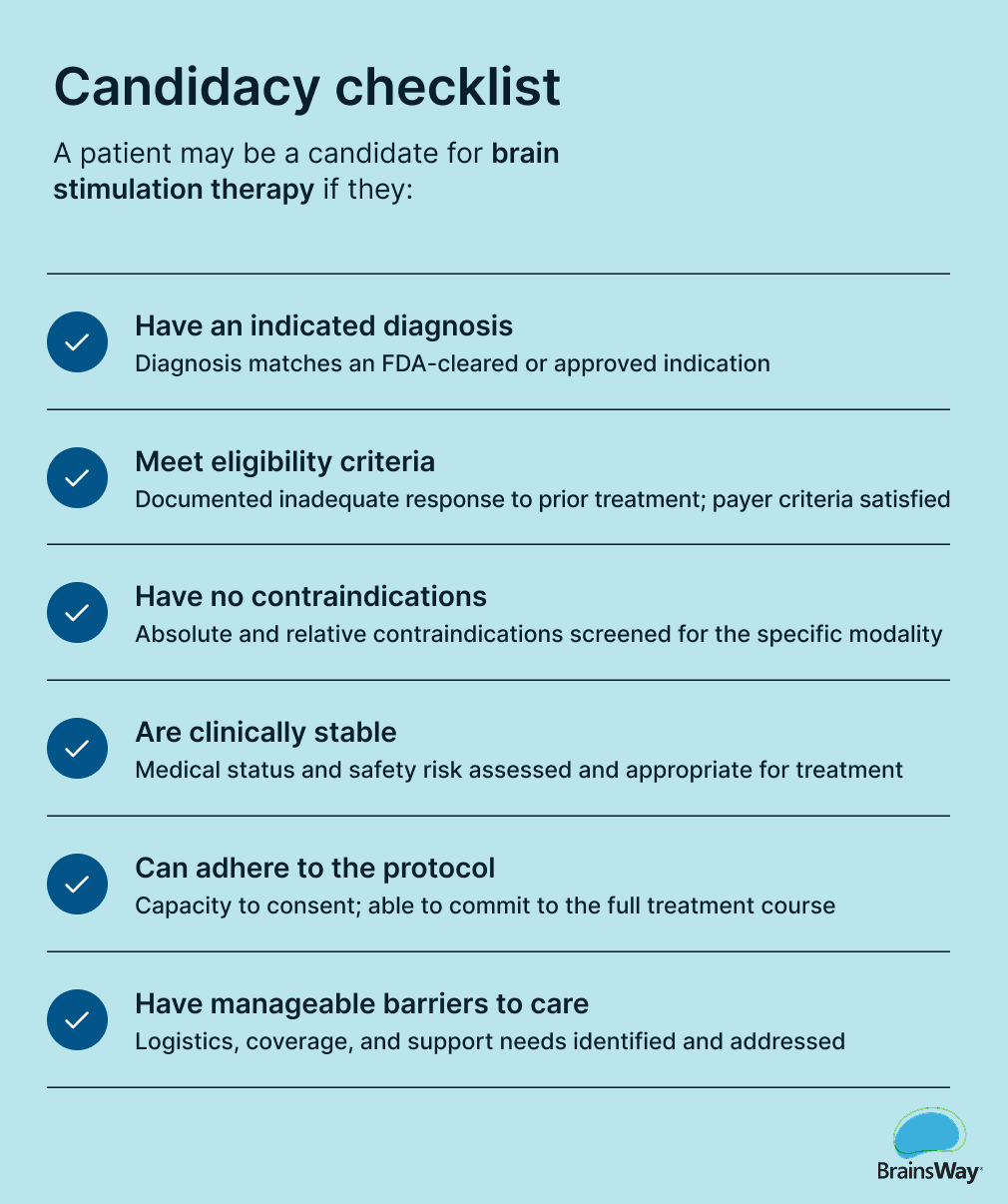
If you’re a provider, you might be exploring how to best investigate whether your patient is a candidate for brain stimulation therapy. Sam Zand, DO, founder and chief psychiatrist at Anywhere Clinic, provides some insight.
“Start with the whole person: their diagnosis, symptom severity, previous treatments, daily functioning, and goals,” he says.
A thorough assessment for a deep brain stimulation modality includes screening for any contraindications.
“We also need to understand practical barriers, such as transportation and scheduling,” he adds. “And a treatment plan has to fit the patient’s life.”
Once you’ve assessed a patient for contraindications and any barriers, you’re ready to talk to them about a specific brain stimulation therapy that might be right for them.
“Start by asking what the patient has learned about the treatment and what concerns them,” Dr. Zand says. “Walk them through the experience.”
He shares the example of TMS. “Let them know they remain awake, wear hearing protection, feel a light tapping on the scalp, and can drive home after treatment,” he says. “Explain possible discomfort or headaches and the rare risk of seizure.”
Sharing the specifics of a treatment, such as TMS, is crucial. “A conventional course often involves weekday visits for four to six weeks, sometimes followed by a taper; session length and the overall schedule depend on the protocol,” Dr. Zand says. “Discuss travel time, work, childcare, and coverage.”
He also likes to share realistic expectations for a modality. Again, he uses TMS as an example. “Improvement may take several weeks, and some people won’t respond,” he notes. “Ask what getting better would look like in everyday life, and track that alongside symptom scores.
Finally, walk patients through any lifestyle changes that may be useful. “I also encourage patients to connect treatment with sleep, movement, meaningful relationships, and psychological support,” he explains. “Our goal is to help someone feel better and build a life that supports staying well.”
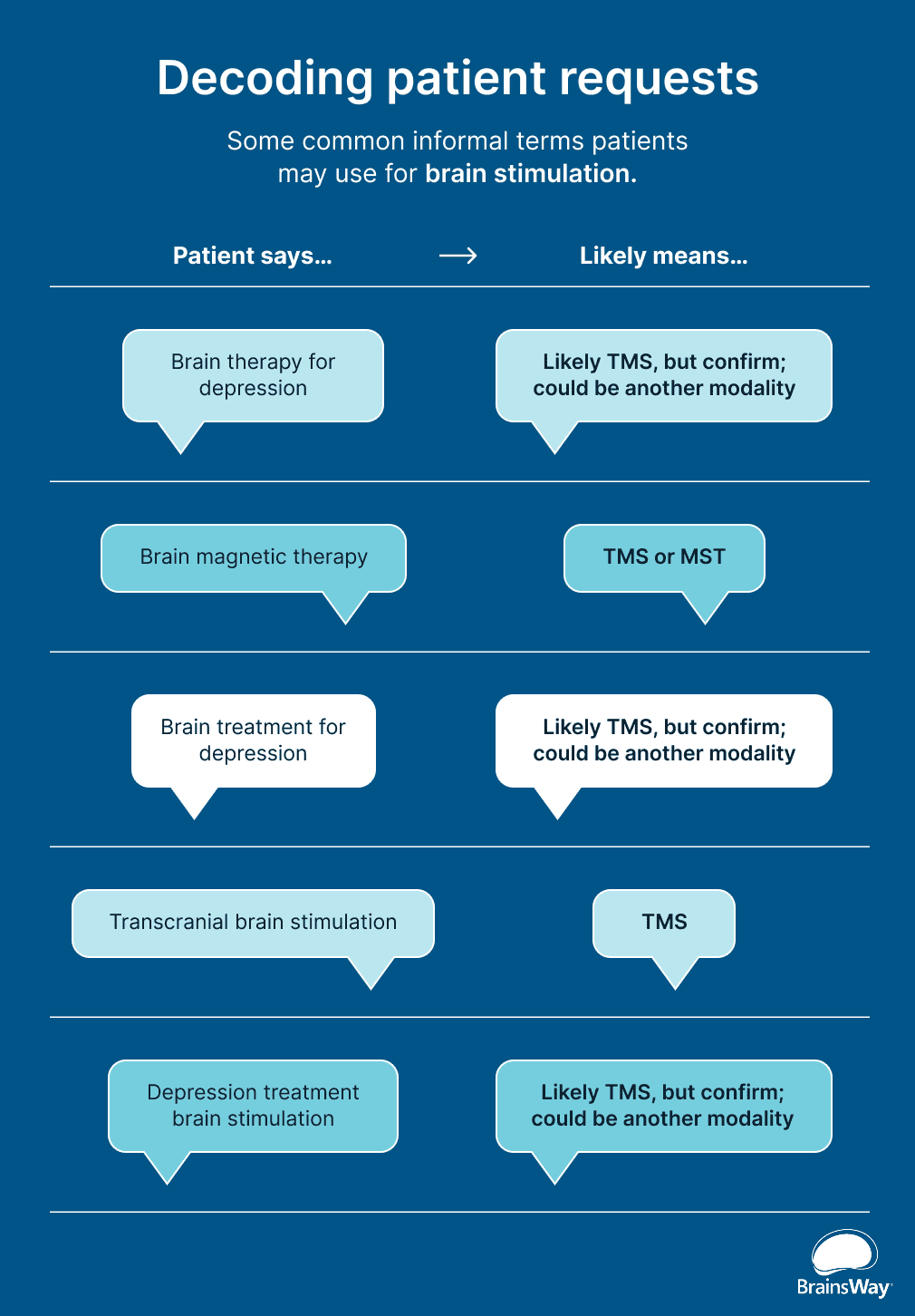
In some cases, your patient may ask for a therapy they’ve heard or read about, sometimes using a different name for it because the terms for various brain stimulation therapies can get confusing. Below are some colloquial terms you might hear and the therapies they likely refer to.
| Patient says… | Likely means… |
|---|---|
| “Transcranial brain stimulation” | TMS |
| “Brain magnetic therapy” | TMS or MST |
| “Brain therapy for depression” | Likely TMS, but confirm; could be another modality. |
| “Brain treatment for depression” | Likely TMS, but confirm; could be another modality. |
| “Depression treatment brain stimulation” | Likely TMS, but confirm; could be another modality. |
If your patient has treatment-resistant depression or OCD, TMS or Deep TMS may be the most appropriate option when considering brain stimulation therapies. Learn more about how TMS and Deep TMS work and BrainsWay’s referral guidance.
“Brain stimulation therapy” is a category of procedures used to treat various mental health, neurological, and movement conditions and disorders.
The subtypes include electroconvulsive therapy, vagus nerve stimulation, deep brain stimulation, magnetic seizure therapy, and transcranial magnetic stimulation. They differ in mechanisms, indications, and FDA status.
Brain stimulation therapies are usually reserved for treatment-resistant cases, especially when medications and other interventions haven’t effectively helped. A brain stimulation therapy might be just the thing that helps your patient find relief.
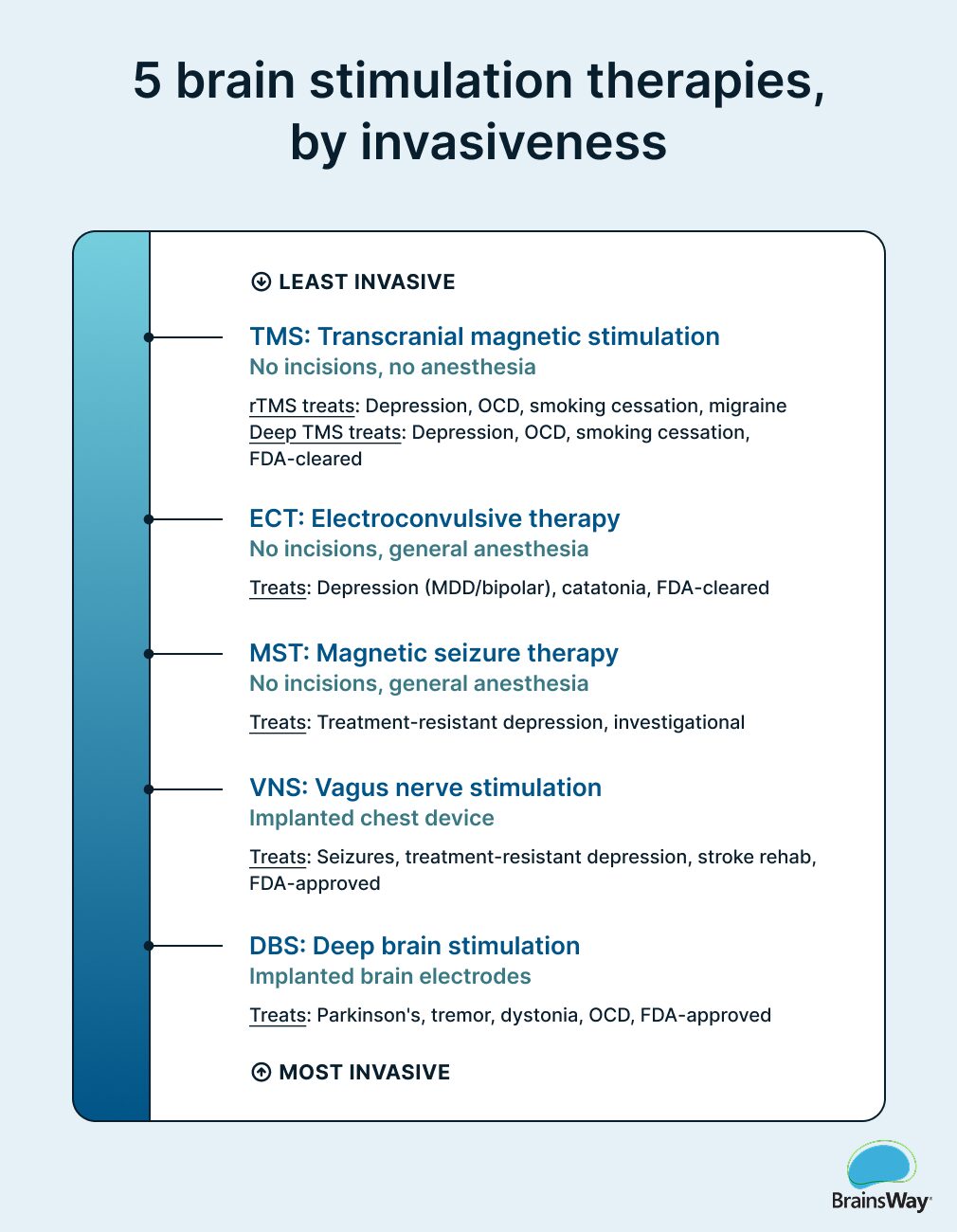
Brain stimulation therapy is a category of treatments that uses electrical currents or magnetic fields to stimulate specific brain areas. The process differs based on the type of brain stimulation therapy. Some types require device implantation while the patient is under anesthesia and are therefore more invasive. Others are not invasive but require anesthesia. And finally, some are noninvasive and do not require anesthesia.
Yes, deep brain stimulation therapy is more invasive than electroconvulsive therapy. Deep brain stimulation requires the implantation of electrodes in the brain and a pulse generator in the chest wall, while the patient is under general anesthesia. Electroconvulsive therapy is also performed while the patient is under anesthesia, but no incisions or device implantations are necessary.
Deep brain stimulation is generally covered by Medicare and Medicaid and most marketplace and private health insurance plans. Plan details vary, but insurance generally covers deep brain stimulation for FDA-authorized indications when the procedure is deemed medically necessary. In many cases, prior authorization is also required. Actual out-of-pocket expenses will depend on the individual’s plan details.