Written by: Elle Warren
Reviewed by: Nina Kalus, PsyD., and Yalda Safai, MD, MPH
When an OCD patient doesn’t achieve an adequate response to first-line treatment, consider other treatment options.
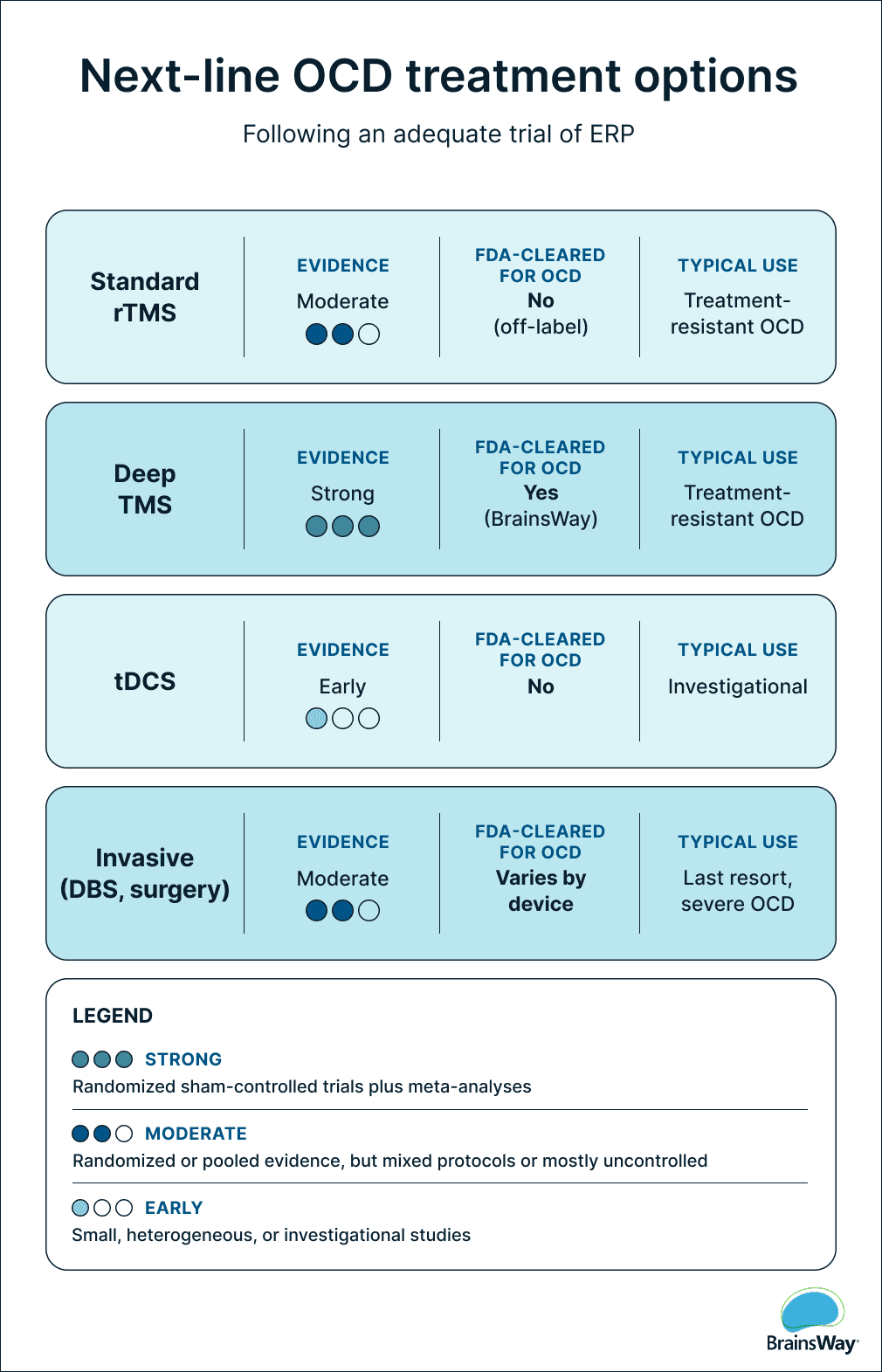
Next-line treatment options include a range of psychotherapy modalities, neuromodulation, such as standard TMS, Deep TMS, and tDCS, and in rare cases, invasive treatments.
Standard TMS may be used off-label to treat OCD, but Deep TMS is FDA-cleared to treat OCD.
The best next-line treatment for a treatment-resistant OCD patient depends on treatment history, symptom severity, and logistical barriers, such as scheduling, transportation, and insurance.
When a patient’s obsessive-compulsive disorder (OCD) symptoms persist after an attempt at first-line treatment, which happens in about 30% of patients, it may be time to consider additional treatment strategies.
Evidence-based next-line treatment options fall into three groups: additional psychotherapy modalities; neuromodulation, including standard TMS and Deep TMS, transcranial direct-current stimulation (tDCS); and, in rare cases, invasive options like deep brain stimulation (DBS), gamma knife, and ablative surgery. This guide covers how to match OCD patients with the right treatment.
It’s time to look beyond first-line OCD treatment when there’s an insufficient response to a selective serotonin reuptake inhibitor (SSRI) or a full course of Exposure and Response Prevention (ERP) therapy. TeeJay Tripp, PsyD, chief medical officer of Serenity Mental Health Centers, notes that a patient doesn’t need to fail both treatments before other options are considered.
Dr. Tripp also explains that it’s important to ensure the initial treatment trial was adequate. “That means an OCD-range medication dose, often higher than depression dosing, for 8 to 12 weeks, or actual ERP with an OCD-trained clinician and practice between sessions.” If it’s determined a treatment trial was not adequate, this should be addressed first before adding in an additional treatment strategy.
When first-line treatment for OCD doesn’t provide sufficient relief, there are a variety of effective next-line options. These include certain types of psychotherapy, transcranial magnetic stimulation (TMS), Deep TMS for OCD, transcranial direct-current stimulation (tDCS), and invasive options like deep brain stimulation (DBS), gamma knife, and ablative neurosurgery.
Next-line treatment options at a glance
| Response/remission | FDA status | Invasiveness | Typical use case | |
|---|---|---|---|---|
| Other psychotherapy modalities | Strongest evidence is for ERP; evidence for other psychotherapy approaches is emerging | N/A | Noninvasive | Alternative/adjunct when ERP alone is insufficient |
| TMS | Randomized sham-controlled studies and meta-analyses support symptom reduction, though it varies by protocol | Standard rTMS is not FDA-cleared specifically for OCD | Noninvasive | Treatment-resistant OCD, used off-label |
| Deep TMS | Randomized controlled evidence supports specific FDA-cleared OCD protocols | BrainsWay’s patented Deep TMS devices are FDA-cleared for OCD | Noninvasive | Treatment-resistant OCD |
| tDCS | Early and heterogeneous evidence | Not FDA-cleared as an OCD treatment | Noninvasive | Primarily investigational |
| Invasive options (DBS, gamma knife, ablative neurosurgery) | Evidence of benefit in highly refractory OCD | Device- and procedure-specific | Invasive | Last-resort treatment for severe, chronic, treatment-resistant OCD |
ERP is the gold-standard, most evidence-based psychotherapy for OCD. However, additional psychotherapy approaches may be considered as an adjunctive or replacement treatment when ERP is insufficient or not well tolerated, including:
One important note: “Garden-variety CBT doesn’t help OCD and can sometimes make things worse,” according to Ben Spielberg, M.S., founder and CEO of Solstice Training Institute. That is, standard CBT-style talk therapy often reinforces compulsive patterns of reassurance-seeking and rumination and the IOCDF advises against using it to treat OCD.
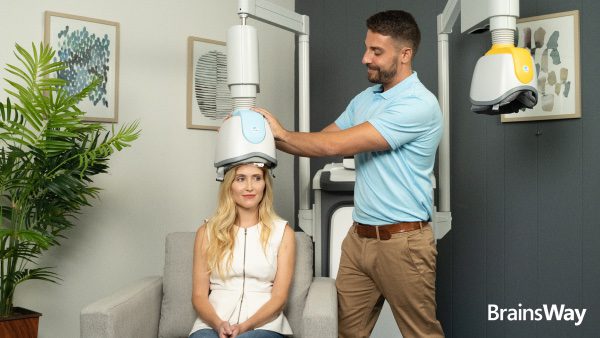
OCD treatment with TMS is a noninvasive form of neuromodulation that uses magnetic fields to influence electrical activity in targeted brain regions. A treatment coil is positioned against the patient’s scalp, and magnetic pulses pass through the skull to stimulate underlying neural tissue. Patients remain awake and do not require anesthesia or sedation.
Standard TMS, also known as rTMS, can include a variety of devices, coils, stimulation frequencies, and brain targets. Standard TMS for OCD is not FDA-cleared, though it’s often used off-label for OCD treatment. In a meta-analysis of 26 randomized, sham-controlled studies involving 781 participants, rTMS was found to produce a “modest” reduction in Y-BOCS scores compared with sham treatment.
Spielberg says that most rTMS devices don’t reach far enough to penetrate the area of the brain implicated in OCD, the anterior cingulate cortex (ACC).
“It’s necessary to use a machine that can penetrate at least 6 centimeters beneath the cortex.” he explains. “This is in contrast to TMS for depression, in which the target brain areas are more superficial than they are with OCD.”
Deep TMS, patented by BrainsWay, uses a specialized H-coil TMS device designed to stimulate broader and deeper regions of the brain than conventional TMS. Deep TMS using a BrainsWay H7, MagVenture Cool DB80, or Nero-MS/D coil at a high-frequency (20 Hz) is FDA-cleared to treat OCD.
FDA-clearance came after a double-blind, multicenter, placebo-controlled study that found more than one in three treatment-resistant OCD patients experienced an improvement in symptoms when Deep TMS was added alongside their existing treatment. At one-month follow-up, response rates were up to 45%, and by the end of treatment, they climbed to over 54%.
In a follow-up to the multicenter study, researchers contacted participating sites to assess durability of Deep TMS for OCD. Among 60 patients across seven sites, more than 86% maintained symptom relief for at least one year. Of those 86%, 43% experienced treatment durability for at least two years, while 62% still had treatment durability at the time of the survey.
Dr. Tripp says Deep TMS is an effective fit particularly for patients with disruptive OCD symptoms who would rather try a non-pharmocological approach.
Transcranial direct-current stimulation (tDCS) uses a low electrical current delivered through electrodes placed on the scalp. Unlike TMS, it does not use magnetic pulses.
Research into tDCS for OCD is still developing. A 2024 systematic review identified 11 randomized controlled trials and found substantial variability in protocols and limitations in study reporting. Only two studies reported a significant difference between active and sham tDCS for OCD outcomes, with small effect sizes. The authors concluded that the available evidence was insufficient to draw firm conclusions about effectiveness. A separate 2024 systematic review and meta-analysis likewise noted that the effectiveness of tDCS for OCD remains debated.
For these reasons, tDCS is currently better characterized as an emerging or investigational approach, not an evidence-based one.
Dr. Tripp considers invasive options for a small number of patients with severe, chronic, disabling OCD who have exhausted everything else, including multiple medications, intensive ERP, and noninvasive treatments like TMS.
DBS involves surgically implanting electrodes that deliver electrical stimulation to targeted brain regions (find the IOCDF’s criteria for DBS here). Gamma knife is a procedure that doesn’t require opening the skull, but rather exposes the skull to multiple gamma rays. Ablative procedures, such as capsulotomy and cingulotomy, permanently disrupt selected neural pathways.
A 2021 meta-analysis of 38 studies found response rates of 48% for ablative surgery and 53% for DBS at 12 to 16 months. At the last follow-up, response rates rose to 56% and 57%, respectively.
Gamma knife is still considered experimental, as existing research sample sizes are small.
The evidence for TMS treatment for OCD supports a nuanced yet clear interpretation. Randomized, placebo-controlled studies show TMS reduces OCD symptoms, but outcomes vary by device, treatment target, stimulation parameters, and patient population.
The 26-study meta-analysis pooled standard rTMS trials that used different stimulation targets and protocols, so its findings don’t translate into one universal TMS OCD success rate. The researchers noted that additional research is needed to establish optimal frequency, pulse number, and treatment duration.
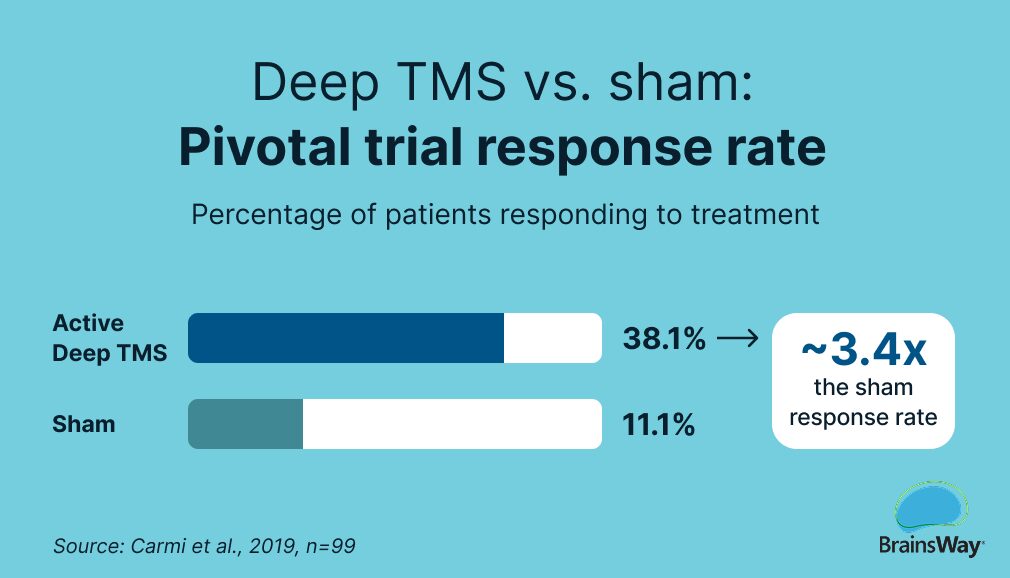
Evidence for Deep TMS, like with a BrainsWay TMS device, is more protocol-specific. The pivotal randomized trial established a 38.1% response rate with active treatment versus 11.1% with sham treatment. A 2024 meta-analysis of randomized controlled trials also found evidence supporting Deep TMS for treatment-resistant OCD, although the authors called for more additional high-quality research.
Real-world data can add context, but should not be directly compared with randomized sham-controlled trials. For example, manufacturer-reported postmarketing data for BrainsWay Deep TMS found that more than 70% of patients reached a first response after an average of approximately 18.5 sessions. More than half achieved a sustained response after approximately 20 sessions. Those numbers are promising, but come from an observational study rather than a randomized controlled trial, so they shouldn’t be interpreted as a universal response rate for Deep TMS.
A typical FDA-cleared Deep TMS protocol for OCD is delivered on an outpatient basis, five days per week for approximately six weeks, totaling 29 treatment sessions.
Some OCD-specific TMS protocols incorporate brief, individualized symptom provocation before stimulation. In the pivotal Deep TMS multicenter trial that led to FDA-clearance for OCD, patients underwent approximately three to five minutes of personalized symptom provocation before each treatment session. The goal was to activate the relevant OCD circuitry immediately before stimulation.
Patients stay awake during TMS treatment, which does not require anesthesia or sedation. They may experience tapping sensations on the scalp during stimulation.
Common side effects can include headache and scalp discomfort. In the multicenter trial, headache occurred in 37.5% of active-treatment patients and 35.3% of sham-treatment patients; the study found no serious device-related adverse reactions.
TMS is not appropriate for every patient. Dr. Tripp says clinicians should screen for metal or implanted devices in or near the head, and for factors that could increase seizure risk. They should also review the specific device’s labeling and contraindications as part of clinical evaluation.
For referral purposes, an appropriate candidate will generally have a confirmed OCD diagnosis, ongoing clinically significant symptoms, and an inadequate response to, or inability to tolerate, appropriate first-line interventions. TMS is generally considered an adjunctive treatment rather than a replacement for ongoing evidence-based OCD care.
Choosing the next best step for OCD treatment must account for a variety of factors, including the patient’s treatment history, symptom severity, comorbidities, preferences, scheduling conflicts, safety considerations, and access to specialized care.
“Intolerance, trouble with exposure, partial response, and misdiagnosis each point somewhere different,” Dr. Tripp says. “I track the Y-BOCS from day one and look for depression, tics, substance use, and family accommodation. I add rather than swap, since medication, ERP, and TMS can run together. Access, travel, and the six-week schedule [of TMS] often decide the next step as much as efficacy does.”
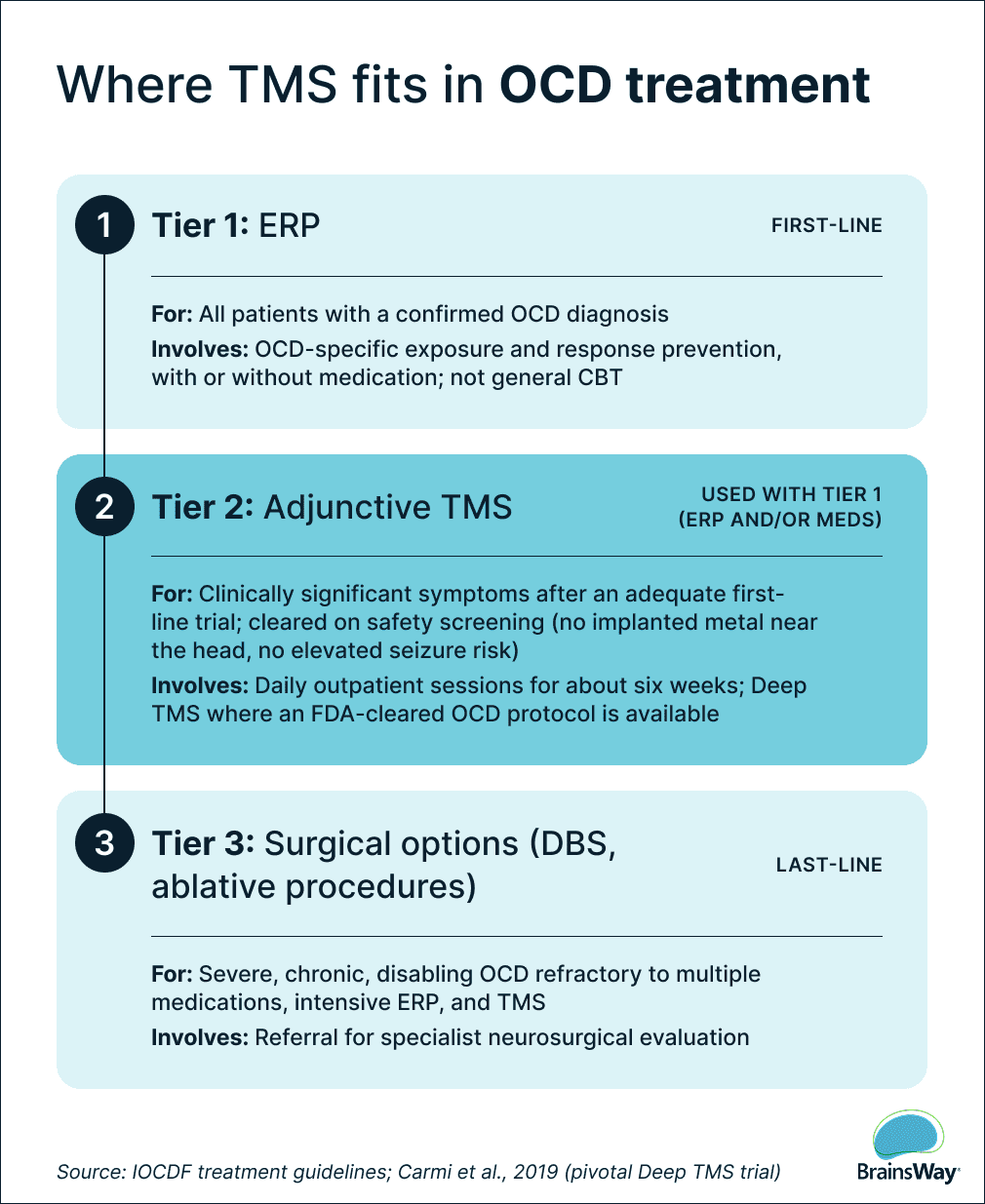
For patients who still have significant symptoms despite appropriate medication and ERP, clinicians may consider TMS therapy for OCD as an adjunctive treatment. Deep TMS may be particularly relevant when an FDA-cleared OCD protocol is available and the patient meets the clinical and safety criteria.
Clinicians evaluating the best TMS devices for OCD treatment in outpatient settings should look beyond the device name. What matters is the device’s FDA-cleared indications, coil design, treatment target, protocol, provider training, safety requirements, and the quality of clinical evidence supporting the specific treatment configuration.
CTA: BrainsWay offers FDA-cleared Deep TMS systems →
TMS for OCD is an evidence-based, noninvasive treatment option for some patients whose symptoms remain significant after first-line approaches. Standard rTMS has demonstrated benefit in randomized trials, but those trials used a range of targets and protocols, so it shouldn’t be treated as interchangeable with an FDA-cleared Deep TMS protocol.
Deep TMS has a more specific regulatory and clinical evidence base for OCD. The pivotal randomized trial showed a significantly higher response rate with active Deep TMS than with sham treatment, with benefits maintained at one-month follow-up and, for some, more than two years. TMS should complement, not automatically replace, ERP, medication, and other evidence-based components of OCD care.
There is no single success rate for all TMS approaches. In the pivotal randomized trial supporting FDA clearance of the Brainsway Deep TMS System for OCD, 38.1% of patients receiving active treatment met the study’s response definition, compared with 11.1% receiving sham treatment. At one-month follow-up, response rates were 45.2% and 17.8%, respectively.
The standard treatment course of Deep TMS for OCD is 29 treatment sessions over six weeks. This protocol involves daily treatment five days per week. Individual treatment schedules may vary according to the device, protocol, and clinician’s treatment plan.
Common side effects may include headache, scalp discomfort, and sensations associated with stimulation. Typically they’re mild and temporary. In the FDA-reviewed multicenter Deep TMS study, headache rates were similar rates in the active and sham groups. Protocols that use symptom provocation can also cause a brief, intended rise in anxiety before stimulation. TMS carries a rare risk of seizure, which appropriate screening can help minimize.
No. Both use magnetic stimulation, but they use different coil designs and stimulation approaches. Standard rTMS generally targets more superficial cortical regions, while Deep TMS uses specialized coils, called H-coils, designed to stimulate broader and deeper brain regions, including those implicated in OCD. Additionally, standard TMS devices are not FDA-cleared to treat OCD, while Deep TMS devices are FDA-cleared.